Updated
October 09, 2026
Published
February 27, 2023
This Week's Highlights
- Main Street Headwinds: While consumer spending remains steady, high prices are shrinking margins and dampening growth on Main Street.
- 2026 Outlook: Negative views of local and national economies have not prevented small employers from expressing high confidence in their own operations, revenues, and cash flow.
- Summary: Negative views of the economy are not keeping small businesses from embracing artificial intelligence (AI) as a catalyst for growth.
Small businesses remain resilient and optimistic in the face of high prices. Small employers are looking to achieve profitability through efficiency.
Tariff Refund FAQ Guide: Visit this guide for information to help small businesses identify whether they paid IEEPA‑based tariffs and prepare for the emerging refund process.
Navigating the New Tax Law: Don't miss our practical guide to maximizing savings for small businesses under the “One Big Beautiful Bill Act.”
ICYMI: As the United States celebrates its 250th anniversary, U.S. Chamber of Commerce President and CEO Suzanne P. Clark unveiled a bold vision for how the business community can help shape the nation’s next chapter. Watch here.
B20 Summit: The B20 Summit agenda is taking shape, with more than 60 confirmed speakers, including several CEOs of global companies and several top reporters who will moderate main stage sessions. Country officials and businesses that make up 3/4 of global trade will take over The Wharf in Washington, D.C., from November 9-11, 2026. Find out more here..
Is your small business a member of the U.S. Chamber? As the nation's leading small business advocacy organization, we can help you with exclusive intelligence and access, a Policy Help Desk, regular updates on economic and business trends, and more.
New Small Business Data
Fiserv September Small Business Index (October 5, 2026)
Insight Summary: Back-to-School purchases boosted spending and higher prices boosted checkout totals. Shopping foot traffic continued to decrease.
- Month over month sales at small businesses rose in September (+0.7%) and year over year sales continued upward (+2.2% compared to September 2025).
- Average checkout totals rose 4.2% compared to a year ago, continuing the trend of higher spending per visit rather than increased customer traffic.
Impact of Technology on U.S. Small Business (5th Annual) (October 2, 2026)
Insight Summary: 2026 is the year of small business AI use and the technology is proving to be a catalyst for growth.
- Nearly 100% of small businesses use at least one technology platform and 41% use 6+ platforms (9 point increase since 2025 and nearly triple the utilization of 6+ platforms since 2022).
- 66% of small businesses use artificial intelligence (AI) (8 point increase since 2025 and nearly triple the usage since 2023).
- Small businesses that use AI are at least 7 points more likely to report sales, profit, and workforce growth than non-AI enabled small businesses.
- 47% of small business owners report that AI use is creating jobs and 6% report that AI is enabling staff reductions.
- 78% of small businesses that use AI report that limiting access to AI would slow growth and 75% report that limiting access to AI would hurt their bottom line.
- 66% of small businesses report that data centers have a positive impact on local economies and 68% believe that data centers have a positive impact on the U.S. economy.
- 95% of small businesses that use AI are working to upskill employees to broaden AI-use, comfort and knowledge. Of those companies 47% are providing on-the-job-training for using AI.
WSJ/Vistage Small Business Small Business CEO Confidence Index (October 2, 2026)
Insight Summary: Confidence in economy was pushed below the12-month average and confidence in revenue, investment, and profitability remains steady.
- 12% of small business owners say the economy has improved compared to a year ago (6 points lower than August) and 50% say the economy has gotten worse (10 points worse than August).
- 18% of small business owners believe the economy will improve in the next 12 months (7 points worse than August) and 36% believe the economy will worsen (7 points worse than August).
- 51% of small businesses plan on increasing employees in the next 12-months (6 points higher than August) and 10% plan on decreasing employees (2 points better than August).
- 35% of small businesses are expecting to increase fixed investments (3 points higher than August).
- 61% of small businesses expect increased revenues in the next 12 months (no change from August) and 9% believe revenues will decrease (5 points better than August).
- 45% of small business owners believe profitability will increase in the next 12 months (2 points worse than August) and 16% believe that profitability will decrease (6 points better than August).
National Federation of Independent Business (NFIB) September Jobs Report (October 1, 2026)
Insight Summary: Job openings and hiring at small businesses slowed in September.
- 32% of small business owners reported job openings they could not fill in August (3 points lower than August). The historical average is 24%.
- 51% of small business owners reported hiring or trying to hire in August (5 points lower than August) and 87% of those who hired or tried to hire reported few or no qualified applicants for the positions they were trying to fill (5 points higher than August).
- 28% of small business owners raised compensation in August (3 points lower than August) and 20% plan on raising compensation in the next 3 months (2 points higher than August).
- 26% of small business owners cite “labor quality or availability” as their single most important problem (3 points higher than August) The historical average is 12%.
- 17% of small business owners plan on creating new jobs in the next 3 months (no change from August). The historical average is 11%.
Justworks and U.S. Chamber of Commerce Small Business Index for Q3 (September 30, 2026)
Insight Summary: Small business owners remain resilient, with elevated confidence in their businesses’ health and cash flow. More small employers are offering benefits to keep their best employees.
- 70% of small businesses are confident in the health of their own business (1 point higher than last quarter) and 72% are comfortable with their current cash flow (2 points higher than last quarter).
- 33% of small business owners are positive about the health of their local economy (no change from last quarter). 36% say their local economy is “about average” (8 points higher than last quarter) and 30% are negative (6 points better than last quarter).
- 27% of small business owners are positive about the nation’s economic health (3 points lower than last quarter). 22% say the national economy is “about average” (5 points higher than last quarter) and 51% are negative (1 point better than last quarter).
- 54% of small business owners rank inflation as their top concern (3 points lower than last quarter and the 19th consecutive quarter where inflation tops the list).
- 38% of small business owners expect to increase investment in their business in the upcoming year (no change from last quarter).
- 62% of small business owners expect to increase revenue in the next year (4 points lower than last quarter).
- 17% of small business owners reported adding staff over this past year (2 points lower than last quarter) and 36% expect to increase staff over the next 12-months (1 point higher than last quarter).
- 46% of small businesses offer health insurance (5 points higher than Q2 2025). 40% offer paid vacation (10 points higher). 31% of small businesses offer dental/vision insurance (10 points higher) and 27% offer retirement plans (5 points higher).
Chase for Business September Small Business Pulse (September 29, 2026)
Insight Summary: Data from August show Main Street’s desire to grow capacity without additional hiring.
- Hiring at small businesses remained at 18% growth year over year (same as June & July).
- Profitability for small businesses dipped in August, but revenues continued to exceed expenses, indicating continued resilience.
- Small businesses report using artificial intelligence (AI) to augment existing capabilities, expanding capacity without hiring additional staff.
Bank of America Institute Small Business Checkpoint (September 24, 2026)
Insight Summary: Smaller firms outpaced their larger counterparts in profitability growth and hiring in August.
- Small businesses with under $5 million in annual revenue experienced higher profitability growth in August than small businesses with revenue between $5 million and $50 million.
- Small businesses with under $5 million in annual revenue accelerated hiring more in August than small businesses with revenue between $5 million and $50 million.
- Artificial intelligence (AI) spending is about level (20%) for firms with under $5 million in revenue and firms between $5 million and $50 million.
- Delinquency rates for business loans remains below the 20-year historical average and declined in Q2 of this year.
Small Business Fast Facts

Honoring America's Top Small Businesses

Explore More Small Business Insights
The U.S. Chamber's SVP of Small Business Policy Tom Sullivan appears regularly on ASBN - America's Small Business Network and hosts a weekly podcast to deliver fresh insights on small business to viewers and listeners nationwide.
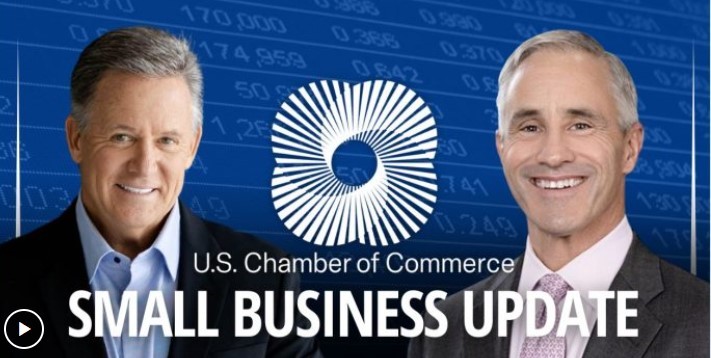
Watch Tom Sullivan talk all things small business with Jim Fitzpatrick on ASBN (America's Small Business Network), including the latest news and policy updates for Main Street business owners. New episodes are added every month so that you can watch them anytime.
Small Business Outlook Podcast
Listen to the Small Business Podc(AI)st for more insights from the U.S. Chamber's Tom Sullivan and NFIB's Holly Wade. Each week, they combine their own expertise with the latest AI tools for podcasting and music editing to deliver an AI-cast that keeps you entertained and up-to-speed on everything small business.
From Main Street


About the author

Thomas M. Sullivan
Thomas M. Sullivan is senior vice president of small business policy at the U.S. Chamber of Commerce. Working with chambers of commerce and the U.S. Chamber’s nationwide network, Sullivan harnesses the views of small businesses and translates that grassroots power into federal policies that bolster free enterprise and reward entrepreneurship. He runs the U.S.