
The Telephone Consumer Protection Act (TCPA) was signed into law in 1991 to curb the increase of abusive and unwanted telemarketing practices. Due to the private right of action it contains, the TCPA has long been abused by the trial bar to sue companies that communicate with their customers. The U.S. Supreme Court ameliorated these litigation abuses somewhat in its 2021 Facebook, Inc. v. Duguid decision, but businesses continue to be subjected to significant litigation, and the American public continues to receive a significant number of illegal calls so interest from policymakers at the national and state level remains high.
TCPA Glossary
TCPA FAQs
Facebook v. Duguid
In April 2021 the U.S. Supreme Court handed down an important TCPA-related decision in Facebook v. Duguid, where it narrowly interpreted the definition of an “automated telephone dialing system” and closed the door on some avenues of abusive litigation. The decision reduced liability exposure for many businesses using automated calling technologies to communicate appropriately with their customers.
While this was a favorable decision, abusive litigation under the TCPA continues to proliferate, and the plaintiffs’ bar continues to try to pin the blame—and more liability—on the business community.
State Mini-TCPAs
The trial bar’s efforts to expand liability under the TCPA extend to the states as well, where they are working to advance “mini-TCPA” legislation. In addition to being subject to the TCPA, businesses are subject to laws in each state that regulate telemarketing and telephone solicitations, often called “mini-TCPAs”. Mini-TCPA legislation often attempts to expand upon the liability and opportunities for abuse under the TCPA by further expanding definitions, such as “autodialer,” or allowing for even higher damages.
A Rise in Class Actions
The proliferation of TCPA litigation has contributed to a significant increase in class action lawsuits, which has had detrimental effects on both businesses and consumers. The TCPA’s provision for statutory damages incentivizes plaintiffs and their lawyers to seek out technical statutory violations, often without actual harm, to aggregate into class actions with the potential for substantial payouts. This trend not only imposes high legal costs on businesses, which are often passed on to consumers in the form of higher prices but also creates a legal environment where the primary beneficiaries of such lawsuits are the attorneys rather than the consumers they purport to represent. The inefficiency of this system is further exacerbated by the fact that many class members receive little to no tangible benefit from these actions, while businesses, especially smaller ones, face the threat of insolvency due to the disproportionate legal burden.
ILR’s new research paper, Expanding Litigation Pathways: TCPA Lawsuit Abuse Continues in the Wake of Duguidoutlines that the Duguid decision did not curb abusive litigation. In fact, “[o]ver half of federal TCPA cases continue to be class actions. This percentage is significantly higher than other federal consumer protection statutes and is growing.”
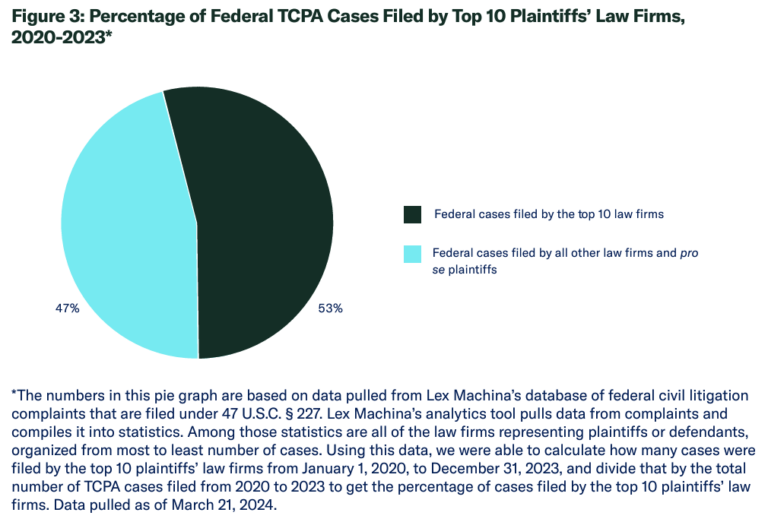
Figure 3 below shows that over the course of 2020-2023, a group of top 10 filers is responsible for over half of federal TCPA filings each year.
Combatting Abusive Litigation
ILR works to combat abusive litigation filed under the statute and to block attempts to expand TCPA liability. In addition to lawsuits filed under the federal statute, a significant amount of TCPA-related activity has moved to the states where plaintiffs are attempting to expand liability with state-focused “mini-TCPAs.”
ILR Testifies Before a Senate Commerce Subcommittee
In October 2023, the Senate Commerce Committee’s Subcommittee on Communications, Media, and Broadband held a hearing titled “Protecting Americans from Robocalls.” ILR’s testimony focused on the good progress that has already been made in reducing robocalls and on urging DOJ to use its current enforcement authority to collect FCC forfeitures rather than adding any additional enforcers to the mix or expanding the TCPA’s private right of action.
More Developments Expected in the Near Future
Despite the progress that has been made, Americans continue to receive a frustrating number of robocalls, and interest in expanding the TCPA remains strong. ILR is engaging with the Federal Communications Commission on this issue after it announced it would consider a rulemaking petition designed to expand TCPA-related liability. We stand ready to engage with the Commission further if necessary. ILR maintains a broad TCPA coalition of partners that enables us to coordinate advocacy efforts. The coalition is opposing the Do Not Disturb Act recently introduced by Rep. Frank Pallone (D-NJ), which would undo Duguid, impose ambiguous and overbroad regulations, and add to the abusive litigation under the TCPA.
TCPA Research
The Institute for Legal Reform’s research program is cutting-edge. We examine the most pressing civil justice issues facing legal systems across the world. We work with some of the world’s foremost legal experts to offer insights and potential solutions for a more just legal system.
Expanding Litigation Pathways: TCPA Lawsuit Abuse Continues in the Wake of Duguid
Abusive litigation under the federal Telephone Consumer Protection Act (TCPA) continues at high levels, despite the U.S. Supreme Court’s 2021 Facebook v. Duguid decision. ILR’s research examines the landscape of TCPA litigation three years after Duguid narrowed the scope of a key threshold issue for liability under the statute—the definition of what constitutes an “autodialer.” As the paper documents, TCPA lawsuit filings declined sharply immediately after Duguid, but they have begun to rise once more.
Read Expanding Litigation Pathways: TCPA Lawsuit Abuse Continues in the Wake of Duguid to learn more.


