- Spotlight
Spotlight: Employee Benefit Offerings
More Offer Key Benefits, Business Size Drives Which Benefits Are Offered
Seven in ten small businesses report offering at least one benefit to their full-time employees, unchanged from Q2 2025, although there has been an uptick in small businesses reporting offering key benefits, like health insurance or paid vacation. In addition, larger small businesses are more likely to report offering benefits.
While the overall number of small businesses offering benefits has not changed, there has been an uptick across many of the types of benefits offered, including:
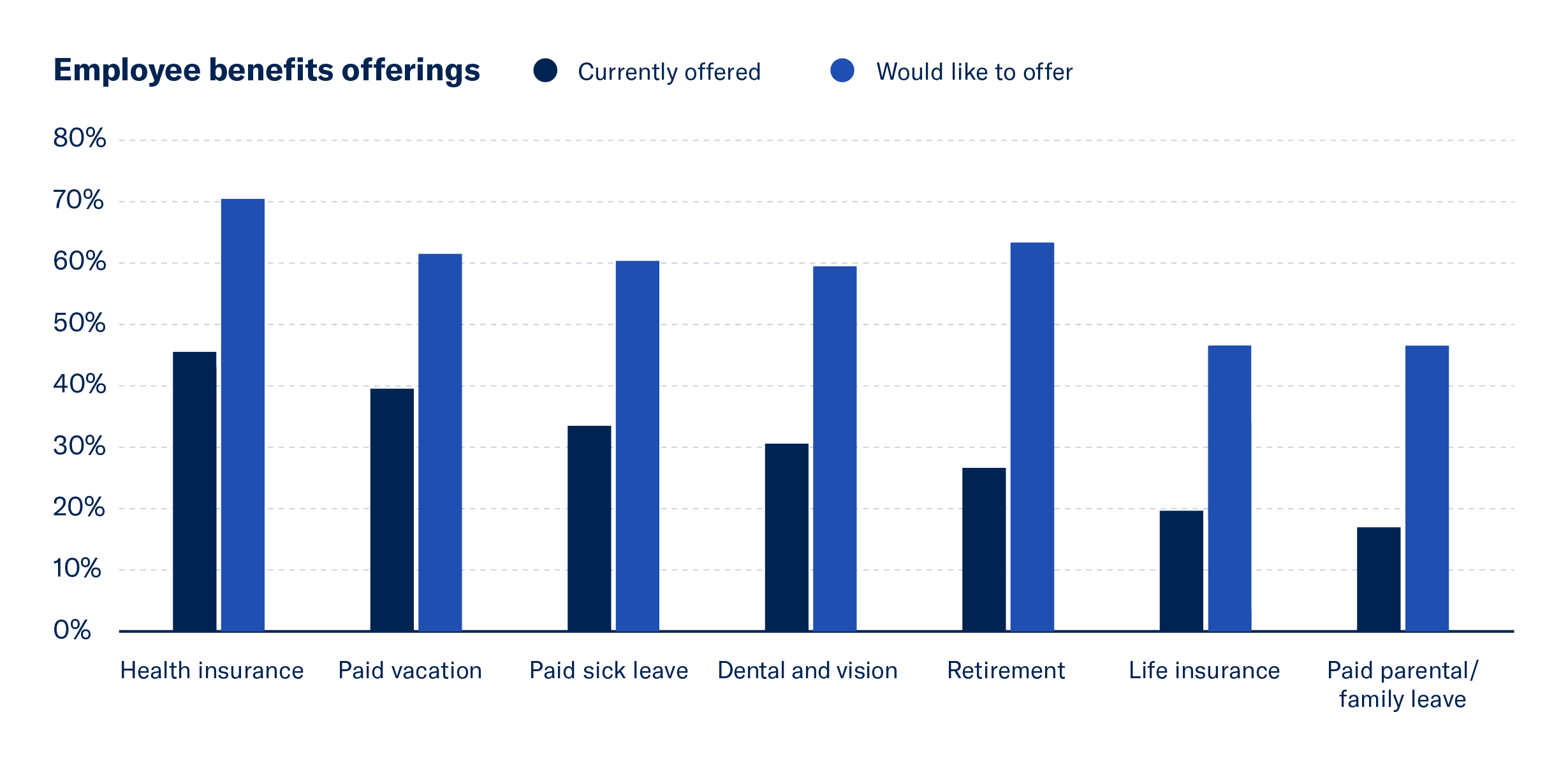
- Health insurance (46%, up from 41% in Q2 2025)
- Paid vacation days (40%, up from 30%)
- Dental and vision coverage (31%, up from 21%)
- Retirement plans (27%, up from 22%)
Business size remains the biggest driver of what benefits are offered. Ninety-eight percent of businesses with 20 or more employees and 88% with 5-19 employees report offering full-time benefits. In comparison, 57% of those with less than five employees offer full-time benefits. By sector, manufacturing businesses are more likely than those in services and retail to offer benefits (81% vs. 65% and 64%, respectively).
When asked what they would offer with unlimited resources, 94% of businesses say they would offer at least one benefit, including 83% of those who don’t currently offer any benefits. Health insurance (71%) tops the list, followed by retirement plans (64%), paid vacation days (62%), paid sick leave (61%) and dental/vision insurance (60%).
Small Businesses Say Benefits Show Care, Boost Employee Productivity
Overwhelming majorities of small businesses say benefits demonstrate care for employees and their families—but also boost productivity, engagement, and morale. They also see benefits as helping to retain employees and attracting new employees.
Small business owners believe employee benefits are important for:
- Demonstrating care for employees and their families (95%)
- Increasing employee productivity and engagement (95%)
- Increasing employee morale (95%)
- Retaining employees (94%)
- Supporting employees at every life stage (94%)
- Decreasing employee stress (93%)
- Supporting workers across different generations (91%)
- Attracting employees (89%)
Eighty-two percent of small business owners who offer benefits say their employees are satisfied with the current offering, a strong majority, but still down seven percentage points from Q2 2025 (89%).
Small businesses view benefits as important but say there are often obstacles to offering them (like cost), and a majority wish they had outside help with offering benefits.
When asked what the most significant barriers are to offering employee benefits, rising costs (35%) and limited budgets (34%) are the most cited. Not having enough employees (a potential barrier to offering benefits included for the first time this quarter) registers at 27% and is more acute among the smallest businesses (35% among those with fewer than five employees vs. 9% of those with 20 or more).
Among all small business owners, most (67%) say they wish they had outside help when it comes to benefits. Notably, Gen Z/Millennial owned businesses (75%) are more likely than those owned by Gen Xers (64%) or Baby Boomers and older (54%) to wish they had outside help.
Employers Rate Employee Experience Highly
Generally, a key advantage for small businesses is their ability to attract and retain talent through a close-knit culture, work life balance, and enhanced job security. This quarter’s findings help reinforce that view.
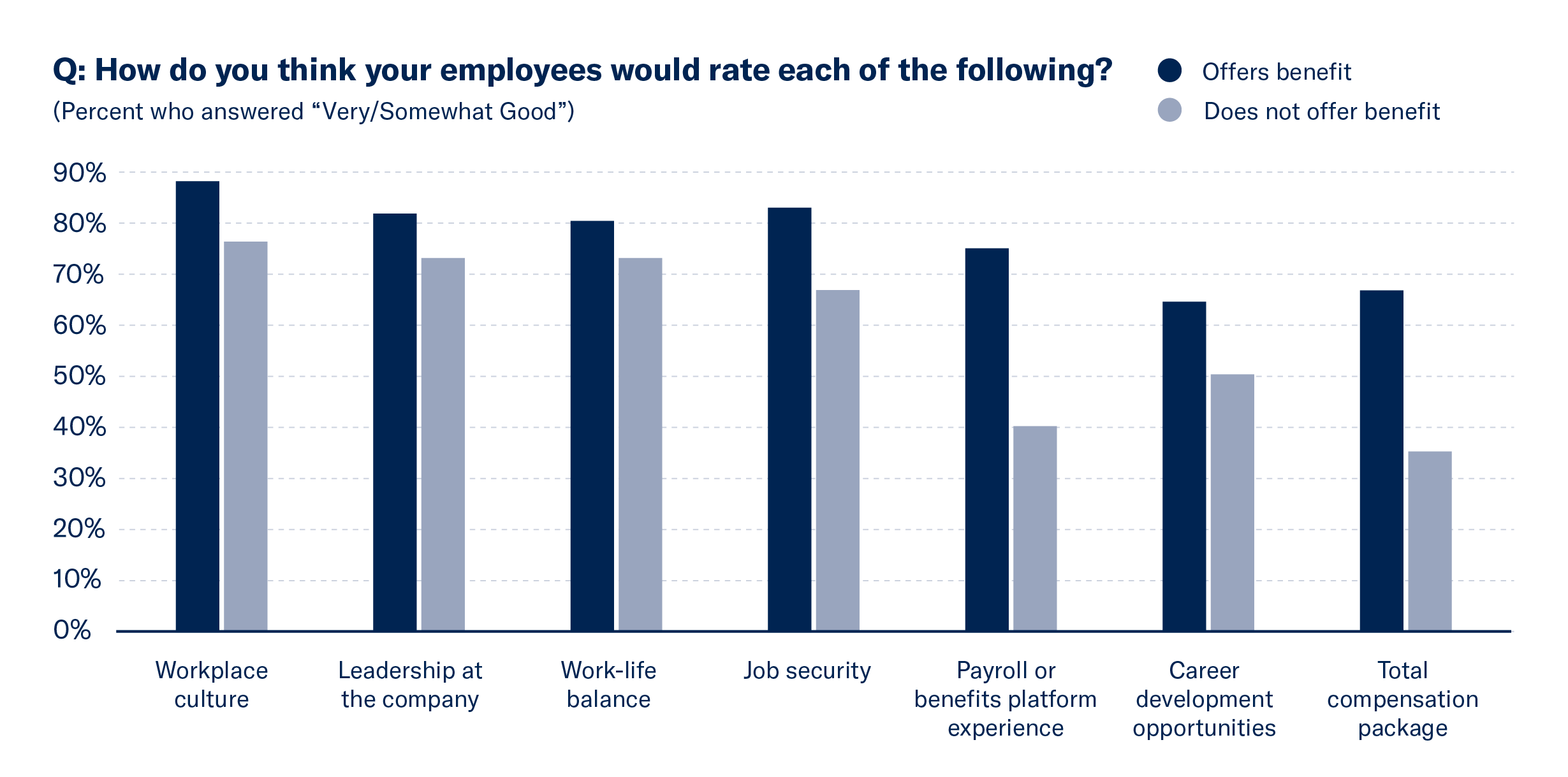
About three in four small business owners think their employees would rate the workplace culture (83%), leadership (79%), work-life balance (77%), and job security (77%) as very or somewhat good. About three in five say the same of the benefits platform experience (64%) and career development opportunities (60%).
Most (57%) believe their employees would rate their total compensation package as good. Notably, businesses with 20 or more employees are more likely to say their employees would rate their total compensation package as good than those with fewer than five employees (70% vs. 50%). Additionally, small businesses that offer benefits believe their employees have more positive perceptions across nearly all attributes than those who do not offer benefits.
There is some indication that small employers are struggling to keep up with workers’ pay expectations in a time of higher inflation. When asked what they believe is negatively impacting the employee experience at their businesses, pay not keeping up with the cost of living (37%) and uncertainty about the economy (37%) top the list, helping underscore how important small businesses believe compensation and keeping up with employee pay expectations are to their employees.
Most Offer Employee Training or Benefits

A majority (75%) of small business owners report investing in training or growth opportunities for their employees. Larger businesses are significantly more likely than their smaller counterparts to say they invest in training opportunities (89% among those with 20 or more employees vs. 69% of those with fewer than five employees). In addition, most small businesses agree that they are uniquely qualified to provide employees with support from management (82%).
Yet many small business owners are showing signs of strain. Fifty-eight percent agree that it is challenging to keep up with their employees' pay expectations or demands, and 53% are concerned about employee retention issues caused by stress or burnout.
In the same vein, nearly half (49%) say they are struggling with their own work-life balance, up from 42% in Q3 2023. A similar percentage also agree that they don’t have the time or resources to focus on their employees the way they would like to (45%). By generation, Gen Z/Millennial owners (54%) are more likely than owners in the Baby Boomer generation or older (37%) to struggle with work-life balance.
Small Business Outlook Holds Steady as Inflation Concerns Grow
Download One-Pager