- Key Findings
Key Findings: Operations, Environment & Expectations
Small Business Operations: Businesses Report Stable Health, Cash Flow
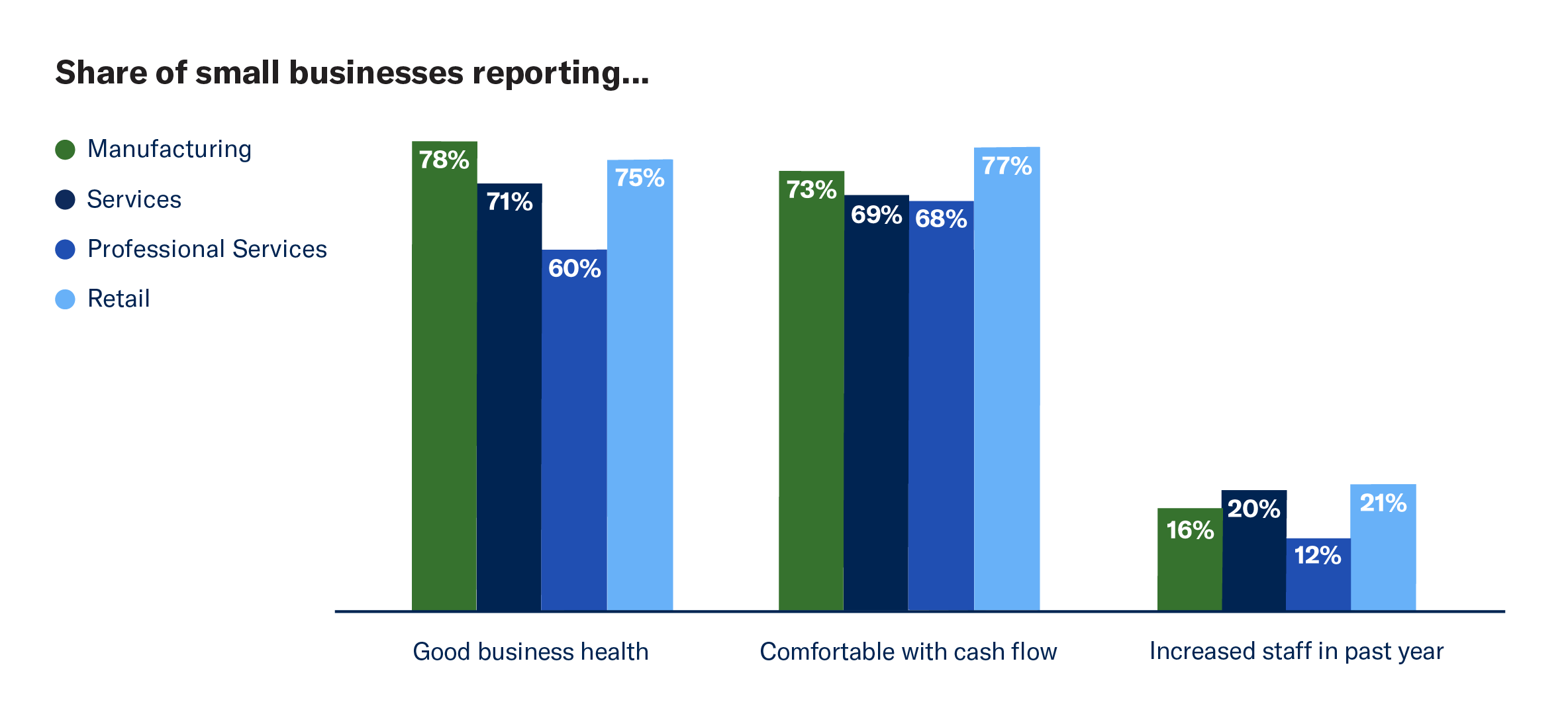
Seven in ten small business owners rate their business as being in good health (71%), stable from last quarter. Thirty-five percent now rate their business health as very good, an eight-percentage point increase from last quarter (27%).
A majority of small businesses report being comfortable with their cash flow (72%). In fact, 22% are very comfortable, up from last quarter (16%) but down significantly from Q3 2025 (31%).
Additionally, 17% report increasing staff in the past year, stable from Q2 (19%) but down 11 percentage points from this time last year (28%).
Retail businesses hold more pessimistic views toward their business health than those in manufacturing and professional services. By generation, Gen Z and Millennial owners are most likely to report good business health and comfort with cash flow.
Small Business Environment: Views Of Economy Stable In Short Term, More Negative Over Long Term
Perceptions of the national and local economy are largely stable compared to last quarter. However, overall views are lower than they were at this time last year.
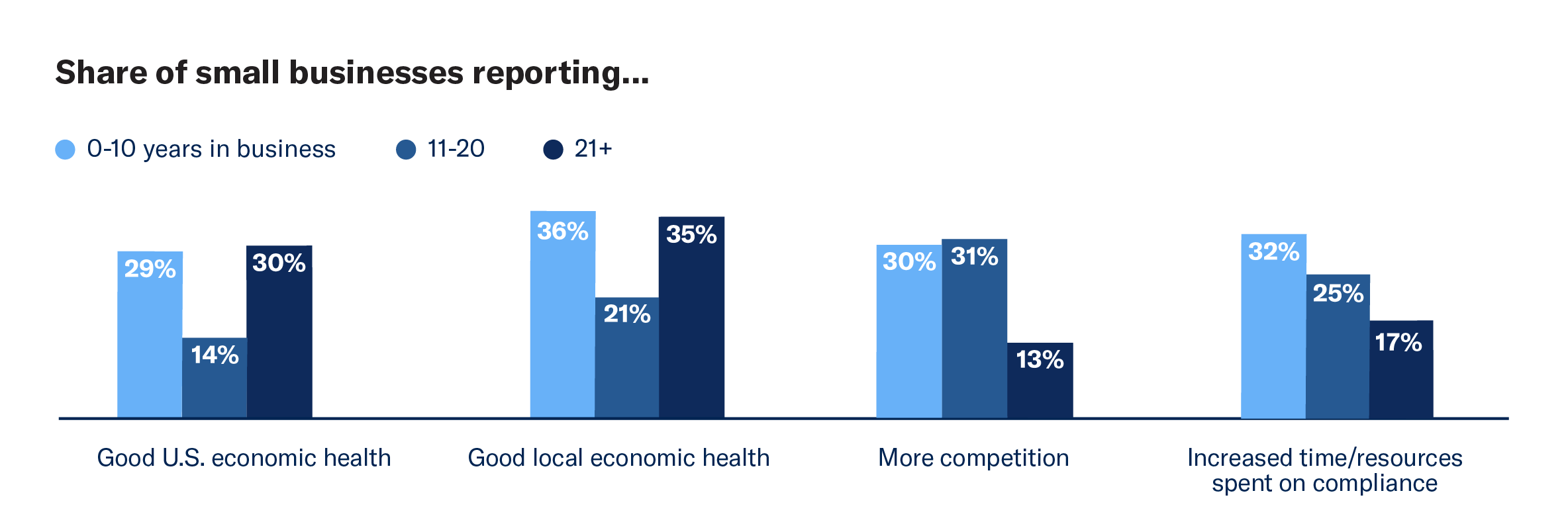
Twenty-seven percent of small businesses rate the health of the U.S. economy as good this quarter, similar to attitudes from Q2 2026 (30%). In the same vein, 33% say their local economy is in good health, unchanged from last quarter. However, this represents a sustained drop on both measures, which are down 13 percentage points from Q3 2025 (40% and 46%, respectively).
Less small businesses see an increase in competition (28%) compared to Q3 2025 (38%). In addition, fewer small businesses say they are spending increased time or resources on compliance (29%), down from last quarter (37%) and returning to levels seen in Q1 2026.
For the fourth consecutive quarter, businesses in the services sector hold more pessimistic views of the national and local economies than other sectors. By generation, businesses owned by Gen Z or Millennials hold more positive views of the current environment than those owned by Baby Boomers or older individuals.

Less small businesses see an increase in competition (28%) compared to Q3 2025 (38%). In addition, fewer small businesses say they are spending increased time or resources on compliance (29%), down from last quarter (37%) and returning to levels seen in Q1 2026.
For the fourth consecutive quarter, businesses in the services sector hold more pessimistic views of the national and local economies than other sectors. By generation, businesses owned by Gen Z or Millennials hold more positive views of the current environment than those owned by Baby Boomers or older individuals.
Small Business Expectations: Expectations Remain Stable, But Are Down From Year Ago

As inflation concerns persist, business owners hold cautious views about the future. Expectations for future staffing and investment remained stable compared to last quarter, while future revenue expectations declined slightly. All these measures are down significantly from this time last year.
Thirty-eight percent report that they are planning to increase investment in the next year, unchanged from last quarter. Similarly, 36% anticipate increasing staff, in line with Q2 2026 (35%). However, both respective measures are down at least eight percentage points from Q3 2025 (47% and 44%, respectively). On the other hand, 62% expect increased revenue in the next year, a slight, but not significant, downshift from last quarter (66%), and down from this time last year (69%).
By sector, manufacturing and professional services businesses are more likely than those in retail to anticipate increases in staffing and investment in the coming year. There are no significant differences between sectors in terms of revenue expectations. By business size, those with twenty or more employees are most likely to expect increases across all three measures than their smaller counterparts.
Continuing what is now a year-long trend, businesses owned by members of the Baby Boomer generation and those older are more pessimistic than their Gen Z or Millennial counterparts across every measure of future expectations: Revenue (51% vs. 71%), staffing (19% vs. 46%), and investment (18% vs. 50%). Similar differences are present when looking at a business’ length of operation, as younger businesses hold more positive views of the future than older businesses.
Small Business Outlook Holds Steady as Inflation Concerns Grow
Download One-Pager