- Skills and Experiences
Skills and Experiences
Internships Viewed as Most Important Path to Right Skills


Durable Skills and Experience Highly Valued for Entry-Level Talent
Employers are looking for early-career cybersecurity professionals with a mix of cybersecurity experience and durable skills mastery. Although most do not feel that those straight out of high school are ready for the workforce, cybersecurity recruiters feel there are many pathways to the requisite experience and cite internships as a top way to get it.

Decision-Maker Viewpoints
Interview participants often expressed how durable skills and willingness to learn are just as important as technical know-how.
- “The single biggest soft skill, that is a determinant of success for people that we bring into the programs in early careers are critical thinking and problem-solving skills.”
— Simone Bachmann, Managing Director within Cybersecurity & Technology Controls Strategy & Shared Services, JPMC
- “As a leader, I’m looking for a baseline technical competency... layered then with ability to explain a technical solution, the ability to communicate, the confidence to share your opinion and influence others that may not have the same level of expertise as you in your particular domain. Soft skills are almost equally as important as those technical skills.”
— Female, Interview Participant, Head of Governance, Risk and Compliance, Cybersecurity
First, the employers surveyed expect entry-level employees to have a baseline grasp of critically important durable skills. Nearly all of these respondents believe that it is important that their employees learn communication (96%), decision making (97%) and collaboration (97%) before entering cybersecurity, including a majority across each that say it is very important.
Second, employers are looking for work experience. The most cited places these decision-makers believe students gain the skills needed to be successful early in their careers are internships (51%) and 4-year colleges (45%), followed by trade schools/technical colleges (32%) and career and technical education courses (25%).
Notably, survey respondents across manufacturing, retail, and professional services report similar shares (25%-28%) who believe skills are primarily learned in career and technical education high school courses. By contrast, those in professional services (49%) and retail (48%) are more likely than those in manufacturing (38%) to say skills are learned in 4-year colleges.
In-depth interview participants offered additional context about why internships topped the list of experiences necessary for success. Being in an office environment and learning how to communicate and interact with others is a skill that was seen as critical, but sometimes lacking, for entry-level employees. One manager noted the importance of a "real-life practicum"and learning from business practitioners, not just professors or teachers in a classroom.
However, cybersecurity skills are also vital. The poll finds that nearly three in five agree that they don’t consider candidates for open positions that don’t have all the skills they are looking for (59%) and that their company spends too much time on training and upskilling new employees (58%). Notably, Gen Z/Millennial decision-makers are more likely than Gen X to say that their company spends too much time on training or upskilling new employees.
Today’s High School Grads Less Prepared
More than four in five surveyed respondents agree that most students are not prepared to enter cybersecurity roles straight out of high school (85%), and 65% agree that current high school graduates are less prepared to enter the workforce when compared to previous cohorts. A majority across all demographic groups share these sentiments.
When asked about what should be taught in high schools, nearly all survey respondents agree that there should be more courses teaching communication, collaboration, and critical thinking (94%)—those highly-desired durable skills that employers find so important.
Decision-Maker Viewpoints
In-depth interview participants who said that high school courses play a minor or no role in their company's hiring process were asked what would increase their importance.
- “If they held credentials or could display projects they worked on.”
— Male, Age 31, Chief Technology Officer, 5 years of hiring experience.
- “If these high school courses helped students develop portfolios of skills obtained and projects completed, they would be a much better demonstration of the students’ abilities and play a bigger role in the hiring process.”
— Male, Age 36, Department Head, 4 years of hiring experience.
- “More practical IT skills, cybersecurity basics, and hands-on projects would increase their value.”
— Female, Age 41, Chief Executive Officer, 5 years of hiring experience.
- “I look for actual knowledge of candidates. The tests themselves do not matter to me. It is about the actual knowledge they have.”
— Female, Age 41, Department Head, 15 years of hiring experience.
AI Skills and Industry Credentials Are Both Highly Sought After
College/Trade School Grads with Credentials, Experience Seen as Most Prepared
Overall, decision-makers view candidates with an industry-recognized credential as more prepared than those without one. However, credentials alone only go so far. Decision-makers view trade school graduates with credentials as equally prepared as those with internship experience.

Decision-Maker Viewpoints
Many in-depth interview participants highlighted the value of industry-recognized credentials and what they say about a candidate.
- “Most of the time, somebody with a certification is going to show that initiative because they wanted to do it. And it is going to hold a little bit higher value for me… Even if someone’s here for three, five years, we encourage them to continue to learn and to pursue those ancillary certifications.”
— Lou Modano, Executive Vice President, Chief Information Security Officer, and Global Head of Corporate Information Technology, Nasdaq
- “Credentials can demonstrate a strong foundation and understanding of key concepts, but they’re only one part of the equation. What matters most is the ability to apply that knowledge, solve real-world problems and continue building skills as the environment evolves.”
— Deneen DeFiore, Vice President & Chief Information Security Officer, United Airlines
- “If you don’t have that passion to continuously learn the industry, then it can tend to leave you behind. So that really sets you apart when you have those certifications, even though it’s not a hard requirement.”
— Female, Interview Participant, Senior Manager Cybersecurity Recruitment
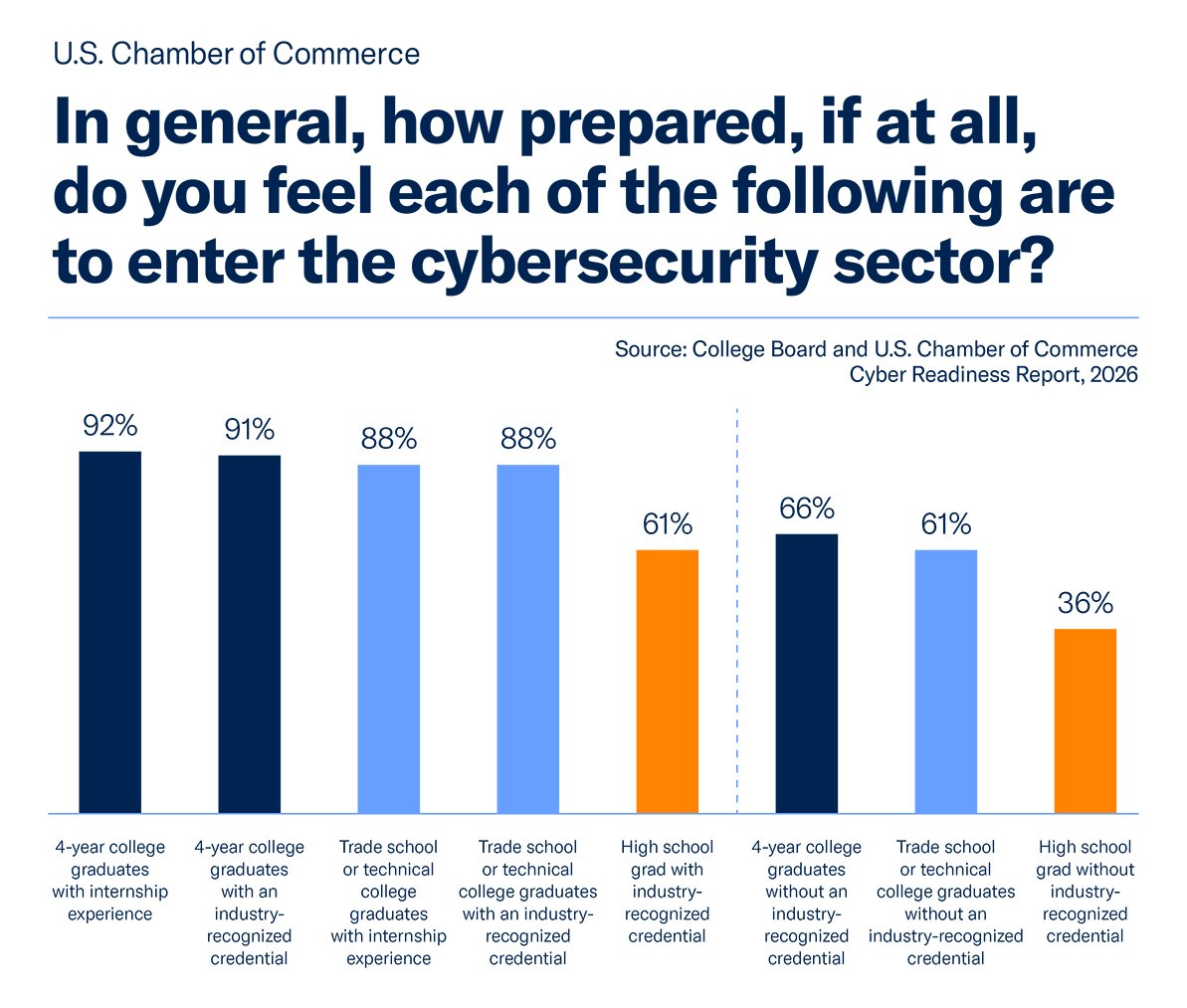
More education, more experience, and more industry-recognized credentials tend to make cybersecurity candidates more attractive to decision-makers. When it comes to high school graduates, those with industry-recognized credentials are seen as much more prepared than those without (61% vs. 36%). Those viewed as most prepared (92%) were 4-year college grads with internship experience, followed closely by 4-year college grads with a credential (91%), trade school grads with internship experience and trade school grads with a credential (both 88%). Among those without a credential, 4-year college grads (66%) were viewed as the most prepared and even more prepared than high school grads with an industry-recognized credential (61%).
Decision-Maker Viewpoints
When asked about their own role in developing entry-level talent, in-depth interview participants consistently described hiring for potential and building technical skills on the job.
- “We have to mentor properly and provide that on-the-job training. People typically think about that in a technical capacity, but on-the-job training is also learning how to interface with people.”
— Michael Priest, SVP and Chief Information Security Officer, financial services industry
- “As I transform my workforce, it's great to give traditional AI training, online courses, go to school, get a certificate. But it's the application of it. So, what we started doing is, every week I have a big general manager call. One person shows how they're using AI... and then we create a video library.”
— Senior Vice President and Chief Information Security Officer
Three in four respondents also say that young adults with internship experience are prepared to enter the cybersecurity sector (74%). A majority across all demographics hold this sentiment. In the same vein, 91% of surveyed decision-makers say they would be more likely to hire an entry-level employee if they have credentials in a relevant field, including 46% who say they would be much more likely. Credentials are highly valued, but similar weight is placed on durable skills such as critical thinking/problem-solving (89%) and communication (88%), as well as internship experience (89%) and leadership experience (83%).
Decision-Makers Very Highly Value AI Skills
In addition to credentials, experience, and durable skills—there is a new, standout fundamental skill that decision-makers in cybersecurity are almost all looking for: AI.
Along these lines, nearly all (97%) surveyed decision-makers view artificial intelligence skills as valuable for employees who are just starting their career in cybersecurity, including 62% who find them very valuable. More than four in five also indicate that they would be more likely to hire an entry-level employee who has training or certification on how to use artificial intelligence (84%).
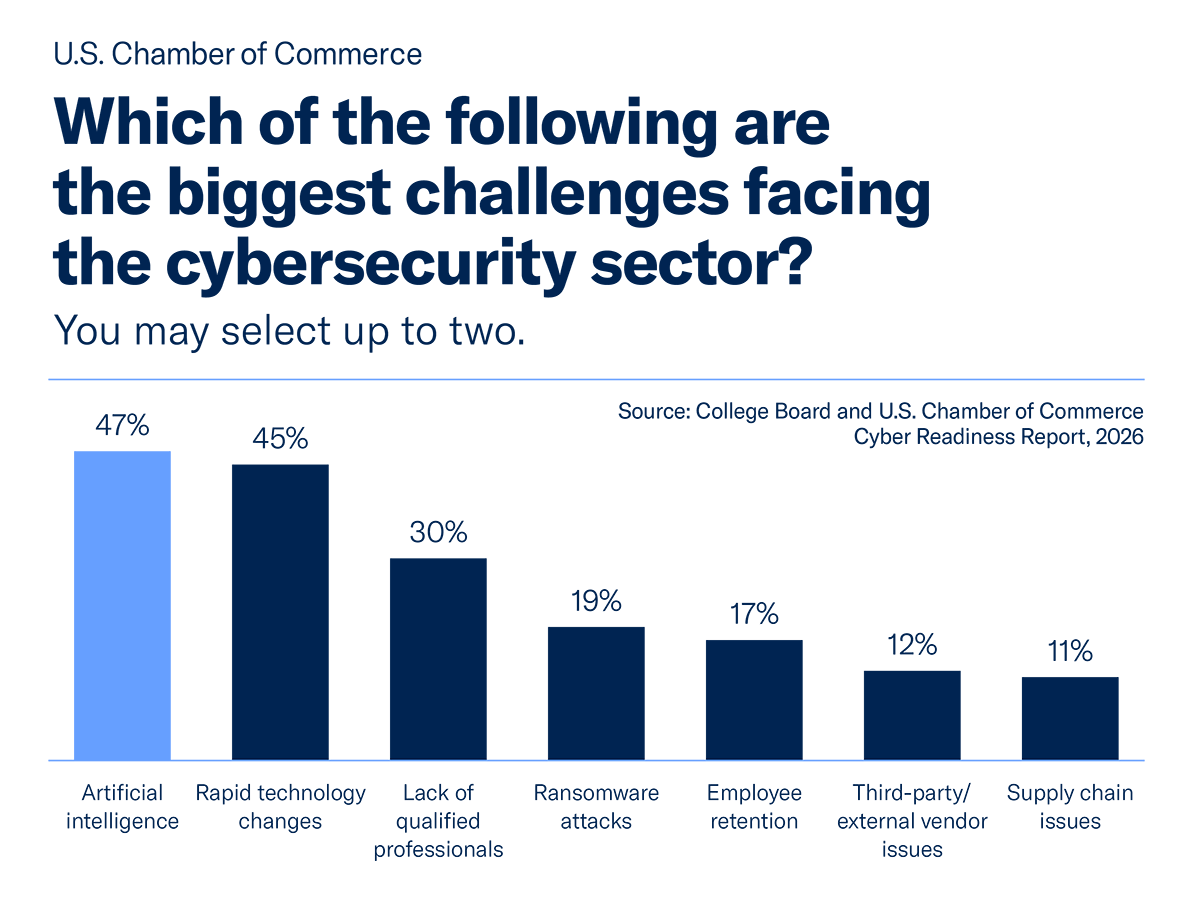
When asked what the biggest challenges are facing the cybersecurity sector, nearly half of respondents surveyed selected artificial intelligence (47%) or rapid technology changes (45%). Three in ten say the biggest challenge is a lack of qualified professionals, while about one in five say ransomware attacks (19%) and employee retention (17%).
Decision-Maker Viewpoints
When asked why they believe artificial intelligence skills are valuable for employees who are just starting their cybersecurity careers, in-depth interview participants said:
- “AI helps entry-level analysts detect threats faster, automate repetitive tasks, and stay ahead of evolving cyberattacks.”
— Male, Age 39, Chief Information Security Officer, 15 years of hiring experience
- “Even if they don’t have a deep understanding of the underpinnings of AI, they do need to have a basic knowledge of its capabilities, applications, strengths, weaknesses, and limitations as AI is becoming a part of EVERYTHING.”
— Male, Age 58, Chief Operating Officer, 16 years of hiring experience
America's leading employers are struggling to find candidates with the right combination of technical experience and workplace skills for today's cybersecurity jobs.
Download Report