- Candidate Quality
Candidate Quality and Preparedness
83% Say Recruits Are Good, but Only 27% Say They Are “Very” Good


New Cyber Hires Are Good Overall, but There Is Room for Improvement
Overall, those surveyed feel that early-career cyber recruits are good and prepared to begin work, but most do not find them very good or very prepared.
Among those who have recruited cybersecurity talent this year, four in five (83%) rate the quality of potential recruits that are applying for positions at their company as good or very good. About one in six decision-makers rate these recruits as fair (16%), while just 1% rate them as poor.
However, while most believe that the current pool of cyber recruits is good, just 27% rate them as very good.
Decision-Maker Viewpoints
In-depth interview participants point out that professionalism and technical know-how are where entry-level candidates often fall short.
- “The biggest gap that we have right now is professionalism. They’re not prepared for interviews and knowing how to work in a professional environment.”
— Female, Interview Participant, Technical Recruiter, Cybersecurity
- “If you ask somebody that just graduated, have you ever logged into a router? Have you ever logged into a firewall? Have you ever built a server? That’s the technical side that universities are lacking – they don’t start out with the basics of building systems or configuring networks.”
— Male, Interview Participant, Hiring Manager
Likewise, among all surveyed decision-makers, 83% say that the entry-level employees hired in recent months are prepared to enter the workforce, though just 30% say they are very prepared.
By generation, Gen Z/Millennial decision-makers are more likely than Gen Xers1 to rate the quality of potential recruits as good (88% vs. 76%) and view their recent entry-level hires as prepared (89% vs 80%). Additionally, those companies with fewer than 20 employees are less likely to view recent entry-level hires as prepared compared to those with 20-499 and 500 or more employees (76% vs. 91% each).
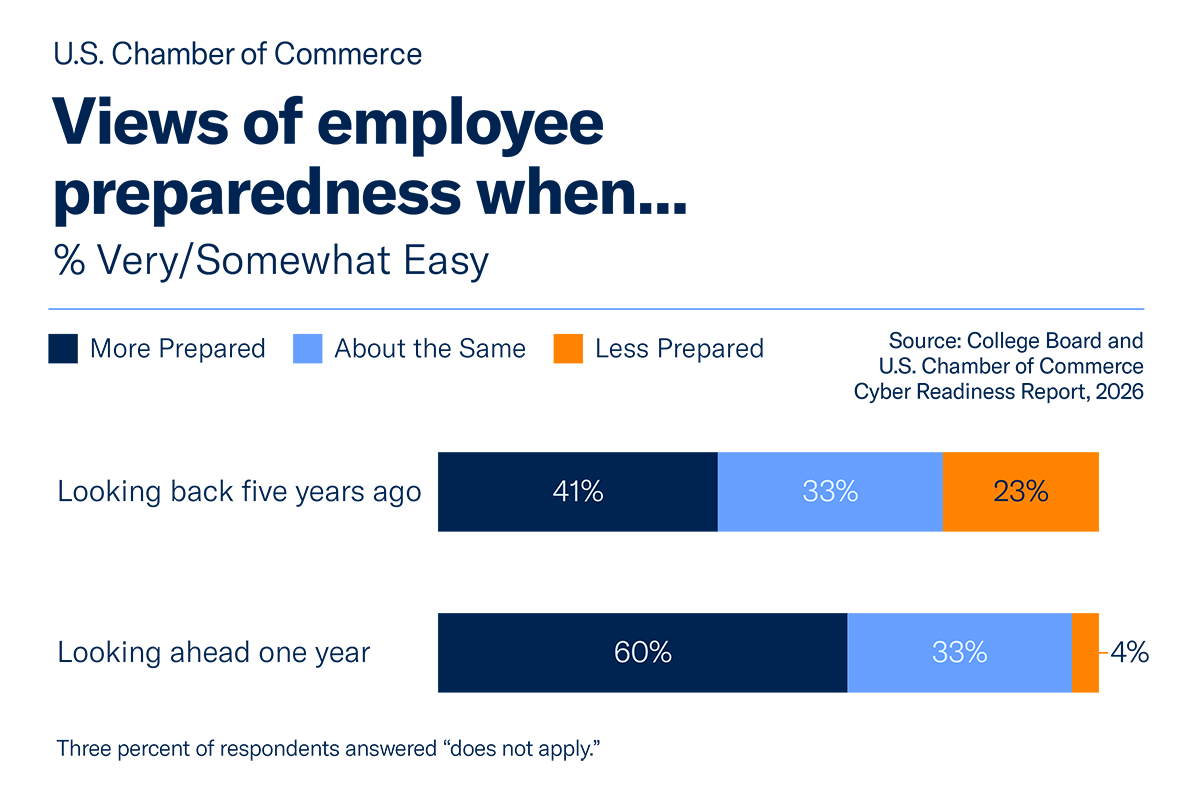
When asked to compare recent hires to candidates that were hired five years ago, two in five (41%) say the past candidates they hired were more prepared than their recent hires. About one in four say the past candidates were less prepared (23%), while one in three say they were about the same level of preparedness (33%).2
Looking ahead, three in five expect the entry-level employees they hire a year from now to be more prepared than the candidates they recently hired. One in three expect future candidates to be as prepared as recently hired candidates, while few expect them to be less prepared (4%).
The decision-makers in this cyber workforce readiness study are more likely to believe that candidates a year from now will be more prepared than the decision-makers surveyed in the 2025 New Hire Readiness Report, a general workforce readiness study with a similar methodology (60% vs. 26%).3
Decision-Maker Viewpoints
When asked whether they expect candidates a year from now to be less or better prepared, in-depth interview participants had a variety of different views.
- “We have better training programs and better AI models than in the past.”
— Male, Age 37, Chief Executive Officer, 10 years of hiring experience, believes candidates will be more prepared.
- “Improved training programs, hands-on learning, and greater familiarity with AI tools should make new hires better prepared for the role.”
— Female, Age 43, Chief Executive Officer, 5 years of hiring experience, believes candidates will be more prepared.
- “Regardless of the level of technical expertise learned in academia, entry-level candidates typically lack real-world experiences that enhance problem-solving skills and critical thinking ‘outside-the-box’ to apply their technical expertise for practical solutions.”
— Male, Age 65, President, 30 years of hiring experience, believes candidates will be about the same level of preparedness.
- “AI has rapidly changed the cybersecurity landscape, and entry-level employees will have more to learn just to make a minimal impact. I expect that they will either know the fundamentals and not the new techniques, or the other way around, but not both.”
— Male, Age 45, Chief Information Security Officer, 15 years of hiring experience, believes candidates will be less prepared.
Few Say It’s Easy To Find Candidates With Experience, Skills They Need
While general sentiments toward entry-level employees are positive, there are signs of struggle under the surface, particularly when it comes to finding candidates with the right combination of skills and experience.
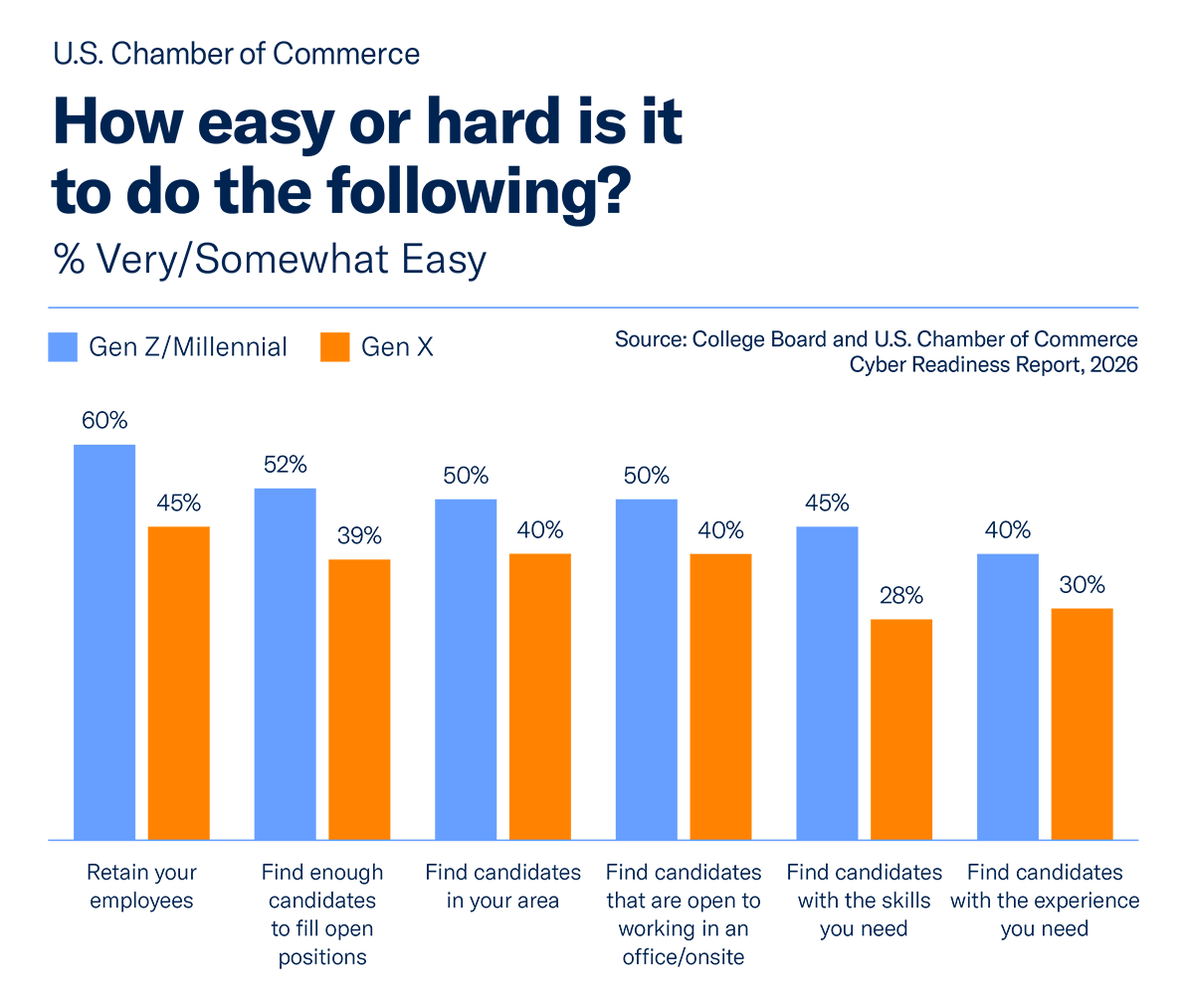
Fewer than two in five say it is easy to find candidates with the skills (37%) or experience they need (35%). For each of these, more feel it is somewhat easy rather than very easy to find candidates with these criteria.
When it comes to keeping the workers they already have, a slim majority (53%) say that it is easy to retain their employees. Just under half say the same of finding enough candidates to fill open positions (46%), candidates in their area (45%), and candidates open to working in an office/onsite (45%).
Across all attributes, Gen Z/Millennial decision-makers are significantly more likely than their Gen X counterparts to say that finding candidates is easy. By company size, those who work at businesses with 500+ employees are more likely than those at companies with fewer than 20 employees to find it easy to retain their employees (61% vs. 47%) and find enough candidates to fill open positions (53% vs. 41%).
More broadly, four in five (81%) surveyed respondents report they have difficulty finding the right candidates.
When asked about potential consequences due to difficulty finding candidates, more than a third said they have spent more time/money training for current staff (37%) or asked staff to work longer hours (36%).
Other actions taken include outsourcing work (30%), hiring temporary staff (26%), having difficulty scheduling work due to lack of staff (20%), and passing on new work due to lack of staff (15%).
Overall, cyber decision-makers largely indicate that they are satisfied with the candidates they’ve hired, but the process of finding these candidates is difficult.
The sample size for Baby Boomers and older is too low to report on (N < 100). Any references to age will focus on Gen Z/Millennial and Gen X respondents.
Three percent of respondents answered, “does not apply.”
New Hire Readiness Report (U.S. Chamber of Commerce and College Board, 2025), https://www.uschamber.com/workforce/new-hire-readiness-report-2025
- 1. The sample size for Baby Boomers and older is too low to report on (N < 100). Any references to age will focus on Gen Z/Millennial and Gen X respondents. ↑ back to text
- 2. Three percent of respondents answered, “does not apply.” ↑ back to text
- 3. New Hire Readiness Report (U.S. Chamber of Commerce and College Board, 2025), https://www.uschamber.com/workforce/new-hire-readiness-report-2025 ↑ back to text
America's leading employers are struggling to find candidates with the right combination of technical experience and workplace skills for today's cybersecurity jobs.
Download Report