- Key Findings
Key Findings: Operations, Environment & Expectations
Business Cash Flow Comfort Continues Decline

Small Business Operations: Business Health Holds Steady

Nearly seven in ten small business owners rate their business as being in good health (69%), matching last quarter, though fewer say their business health is very good (27% vs. 32%).
However, comfort with cash flow continues to soften. Just 16% are very comfortable with their cash flow, down 15 percentage points from Q3 2025 (31%), while overall cash flow comfort has also declined over the same period (69% vs. 76%).
Additionally, 19% report increasing staff in the past year, down from this time last year (28%).
There are no differences in business health or comfort with cash flow by sector, generation, or length of ownership. However, the number that are very comfortable with cash flow has softened or declined among the following groups since last quarter: manufacturing, retail, Gen Z/Millennial owners, and businesses in operation for ten years or less.

Small Business Environment: Views of Economy Are Mixed
Small business perceptions of the national and local economy are mixed this quarter. Overall views stabilized, but more now rate both the national and their local economies as very poor compared to Q1.
Thirty percent rate the health of the U.S. economy as good, in line with last quarter (28%). This is down slightly from Q2 2025 (34%). Similarly, 33% say their local economy is in good health, also stable from Q1 (35%) but a decline from this time last year (41%). Notably, more small businesses rate the national (20%) and local (13%) economies as very poor compared to last quarter (15% and 7%, respectively).
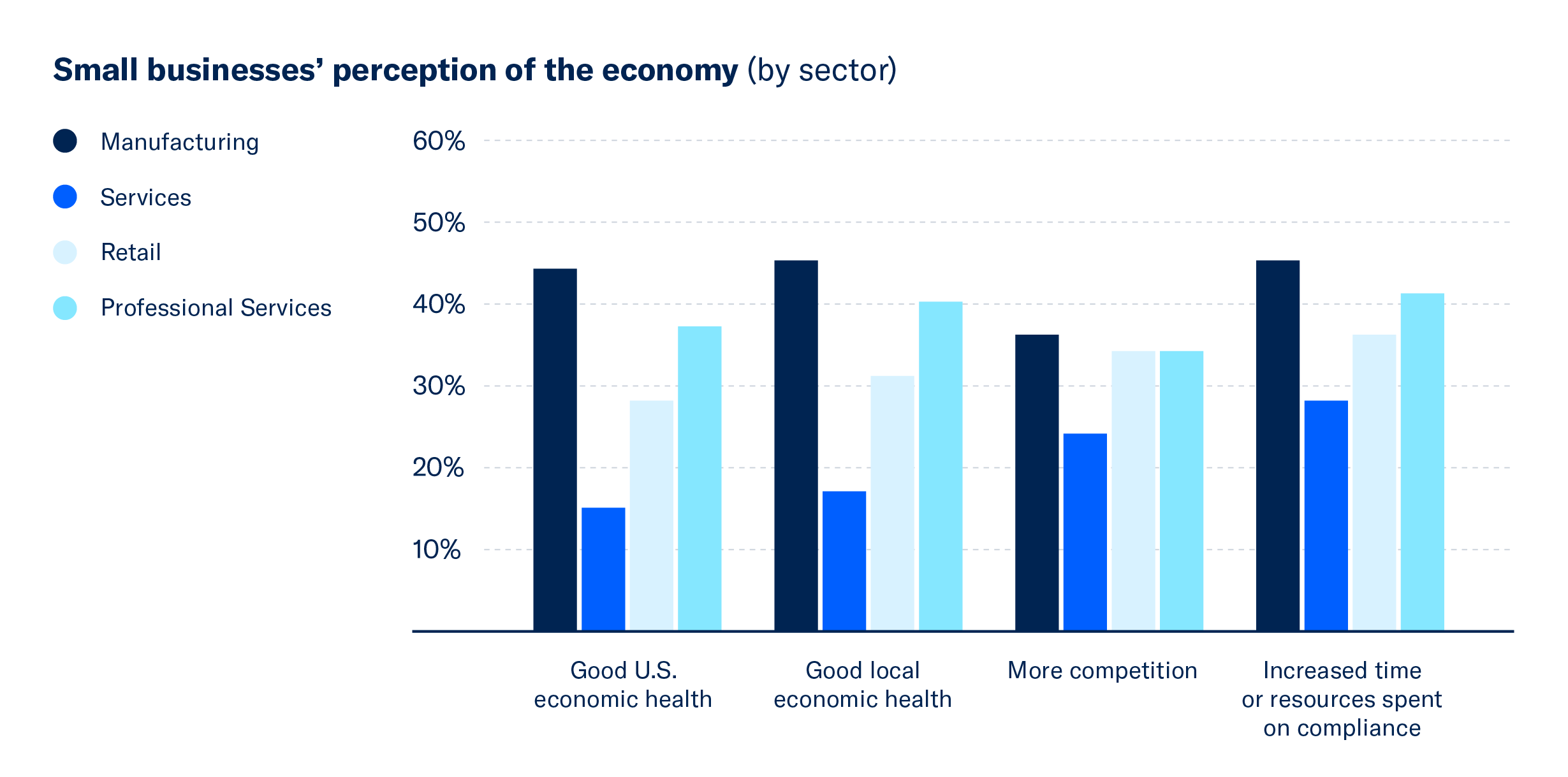
Small businesses are reporting more time spent on compliance, but steady local competition. Thirty-one percent now report seeing more competition from smaller or local companies, a similar percentage to last quarter (28%). On the other hand, 37% say they are spending increased time or resources on compliance, up from 29% in Q1.
For the third consecutive quarter, businesses in the services sector hold more pessimistic views of the national and local economies than other sectors. Only 15% of services see a good U.S. economy, but overall 30% of small businesses do.
By length of operation, businesses 10 years or younger show more optimistic views of the environment than those 21 years and older. Lastly, businesses owned by Baby Boomers and older hold more negative views of the current environment than their younger counterparts.
Small Business Expectations: Small Businesses Anticipate More Future Hiring, Revenue

After falling sharply last quarter, expectations for future revenue and staffing hires rebounded this quarter, while expectations for investment remained flat.
Sixty-six percent (66%) expect increased revenue in the next year, up from 61% last quarter and back near levels seen at this time last year. Similarly, 35% percent anticipate increasing staff, up from 30% last quarter but down from Q2 2025 (42%).
However, 38% report that they are planning to increase investment, in line with last quarter (37%) and nearly 10 percentage points lower than this time last year (47%). At a time when concerns over inflation are at its peak and fewer are comfortable with their cash flow, business owners are less bullish about increasing future investment.
By sector, manufacturing and professional services businesses are more likely than those in services to anticipate staffing increases (43% each vs. 26%). There are no significant differences between sectors in terms of revenue and investment expectations. By business size, those with twenty or more employees remain the most likely to expect increases across all three measures than their smaller counterparts.
Small Business Outlook Holds Steady as Inflation Concerns Grow
Download One-Pager