- Credentials
Credentials, Skills and Experiences
Industry credentials are a talent booster for high school, trade school, and college graduates

When asked how prepared graduates are to enter the workforce, those with an industry-recognized credential are seen as more prepared than those without one. However, that difference is much more pronounced among high school graduates than 4-year college and trade school/technical college graduates.
Talent Booster: Industry-Wide Credentials

Nearly all of these hiring managers view trade school/technical college graduates (90%) and 4-year college graduates (89%) with industry-recognized credentials as prepared to enter the workforce. Fewer (but still a strong majority), say the same of graduates of these institutions that do not have credentials (76% and 74%, respectively).
However, when it comes to high school graduates, those with industry-recognized credentials are seen as much more prepared to enter workforce than those without (71% vs. 40%).
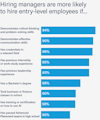
In the same vein, 89% of surveyed hiring managers say they would be more likely to hire an entry-level employee if they have credentials in a relevant field, including 46% who say they would be much more likely.
Credentials in a relevant field are nearly as highly valued by hiring managers as critical thinking/problem-solving (94%) and communication skills (90%)—and ranked as more valuable than having a Bachelor’s degree (68%), internship experience (83%) or leadership experience (83%) in entry-level employees.

Competitive Edge: Real-World Experience
Three in four (78%) respondents say that young adults with internship experience are prepared to enter the workforce. While a majority of these hiring managers view those with internship experience as prepared, companies with at least 500 employees (86%) are more likely to hold this sentiment than those with less than 20 employees (73%) and 20-499 employees (74%).
These hiring managers said that internships are the leading way students gain early-career skills, but that other experience can also help them acquire these skills. The most cited places they believe students gain the skills needed to be successful early in their careers are:
- Internships (46%)
- Trade schools/technical colleges (40%)
- 4-year colleges (37%)
- Career and technical education courses (31%).
Notably, those in manufacturing (37%) and retail (38%) are more likely than those in professional services (22%) to believe skills are primarily learned in career and technical education high school courses. In contrast, those in professional services are more likely to say skills are learned in 4-year colleges (48%).
Hot Topic: Soft Skills
Almost all respondents believe it’s vital that entry-level employees have a baseline grasp of critically important “soft skills” before they enter the workforce.
Nearly all of these hiring managers believe it is important that their employees learn communication (98%), decision making (97%) and collaboration (94%) before entering the workforce, including a majority across each that say it is very important.
What’s more, these hiring managers view “soft skills” as important, regardless of the sector their company is in and are more likely to hire someone if they have them.
At least nine in ten of the hiring managers surveyed (across sectors and ages) say that they are more likely to hire an entry-level employee that demonstrates critical thinking/problem solving or effective communication skills. During in-depth interviews, hiring managers we spoke with also emphasized the importance of these “soft skills”.
The 2025 New Hire Readiness Report reveals that the majority of hiring managers feel that high school graduates are not prepared to enter the workforce.
