- Summary
Executive Summary
Index Falls As Inflation Concerns Grow

Small Businesses Dial Back Hiring, Investment Plans
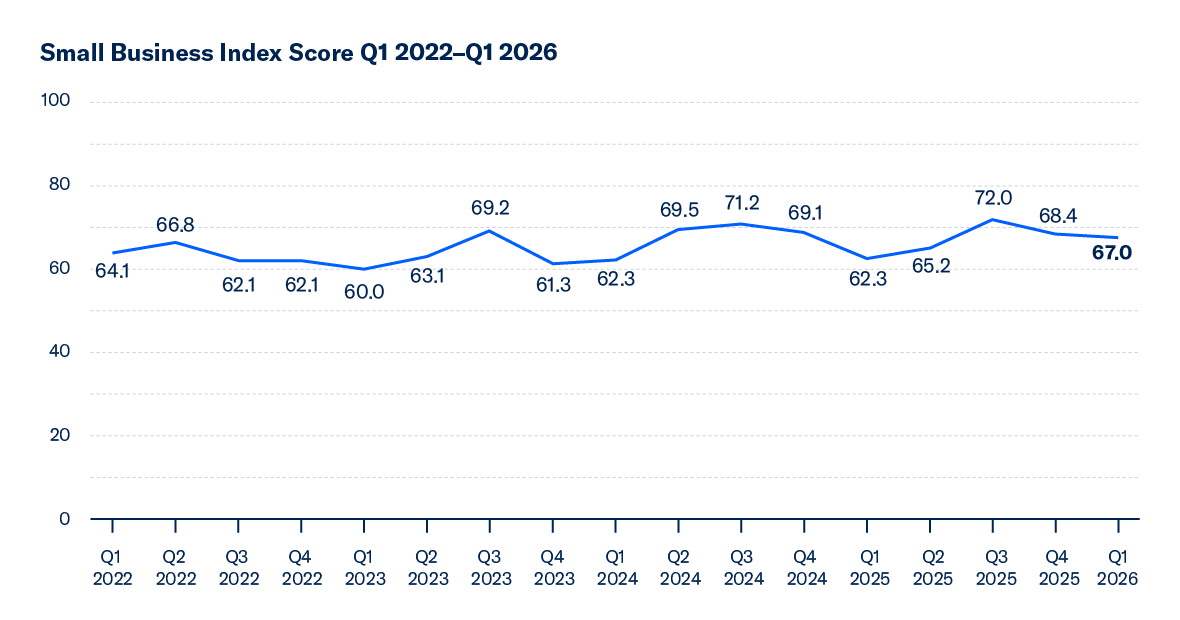
The U.S. Chamber of Commerce Small Business Index is 67.0 this quarter, down slightly from last quarter’s Index score of 68.4. The current score is above this time last year (62.3), but sentiments have declined since Q3 2025 (72.0), when the Index reached its highest point ever.
According to the findings of an Ipsos poll conducted between February 25 – March 11, 2026 (all but three days of the two-week survey period were after the start of military action against Iran), small business views of their own business health remain stable. However, views of the national and local economies are more pessimistic.
This quarter, nearly seven in ten (69%) small business owners rate their business as being in good health. However, 28% of small businesses surveyed say the U.S. economy is in good health, down ten percentage points from Q4 2025 (38%) and in line with this time last year (29%). Thirty-five percent now say their local economy is in good health, down eight percentage points from last quarter (43%) and stable from Q1 2025 (37%).
Additionally, compared to last quarter, significantly fewer small businesses report planning to increase staff or investment in the next year. Thirty-seven (37%) percent of small businesses expect to increase investment in the next year, down from last quarter (44%) and Q1 2025 (43%). Likewise, 30% anticipate increasing staff in the next year, a twelve-percentage point drop from Q4 2025 (42%).
This quarter, inflation continues to be the top challenge small businesses say they face. After three consecutive quarters under 50%, a majority once again say inflation is their biggest concern (53%, up from 45% last quarter). Revenue remains the second most cited challenge at 30% (unchanged from last quarter). Notably, businesses in services and professional services have less favorable views across many measures than those in manufacturing and retail.
Meanwhile, more small businesses are concerned about affording employee benefits. Nearly one in five (19%) say affording employee benefits or healthcare is a top challenge, up from 14% at this time last year. This is highest reading for this measure since tracking began in Q1 2023.
Index Highlights
- Index score declines for second consecutive quarter.
The Small Business Index is 67.0 this quarter, down slightly from 68.4 last quarter but higher than Q1 2025 (62.3).
- Fewer are “very” comfortable with their cash flow.
20% are very comfortable with their cash flow, down 11 percentage points over the past two quarters.
- Fewer see a “good” national economy.
28% say the U.S. economy is in good health, a decline from Q4 2025 (38%) but in line with Q1 2025 (29%).
- Less small businesses see a good local economy.
35% say their local economy is in good health, down from last quarter (43%) but in line with this time last year (37% in Q1 2025).
- Fewer plan to increase investment.
This quarter, 37% of small businesses expect to increase investment in the next year, down from last quarter (44%). Likewise, 30% anticipate increasing staff in the next year, a 12 percentage point drop from Q4 2025 (42%).
- Less expect increased revenue.
61% expect increased revenue in the next year, a slight decline from last quarter (65%) and down from this time last year (69% in Q1 2025).
- A majority say inflation is the biggest concern.
Most (53%) small businesses say inflation is a top concern. This is up from last quarter when 45% said the same. Inflation is the top challenge facing small businesses for the 17th consecutive quarter (over four years).
- More are concerned about affording employee benefits.
19% say affording employee benefits or healthcare is the biggest challenge facing small businesses, the highest point for this measure since tracking began in Q1 2023.
- Services see dimmer economy.
By sector, small businesses in services and professional services show less favorable views of the national and local economies, as well as lower expectations of increasing staffing and revenue in the next year.
Small Businesses Express More Concern Over The Economy Amid Uncertainty
Download One-Pager