- Key Findings
Key Findings: Operations, Environment & Expectations
Divergence Between Own Operations and Larger Economy

Small Business Operations: Fewer Report Being “Very” Comfortable With Their Cash Flow

Small businesses view of their own health and their cash flow comfort are mostly stable this quarter. However, fewer report being “very” comfortable with their cash flow.
This quarter, nearly seven in ten (69%) small business owners rate their business as being in good health, and 72% are comfortable with their current cash flow situation (both in line with attitudes from last quarter). However, the share who are very comfortable with cash flow has declined to 20%, down from 24% last quarter (and 31% in Q3 2025).
Consistent with historical patterns recorded from the start of the study in Q2 20171, small businesses with more employees are more likely to report good business health and comfort with cash flow than those with fewer employees.
Additionally, fewer report increasing staff over the past year. 16% of small businesses report increasing staff in the past year, down seven percentage points from Q4 2025 (23%).
There are no differences in business health by sector. Manufacturing businesses are more likely than those in retail and professional services to report comfort with cash flow (81% vs. 69-70%).
Similarly, manufacturing businesses are more likely to have added staff in the past year than services and professional services businesses (27% vs. 11-12%). Of note, fewer small businesses in professional services are comfortable with their cash flow and report staffing increases compared to last quarter.

Small Business Environment: Views Of Economy Slide
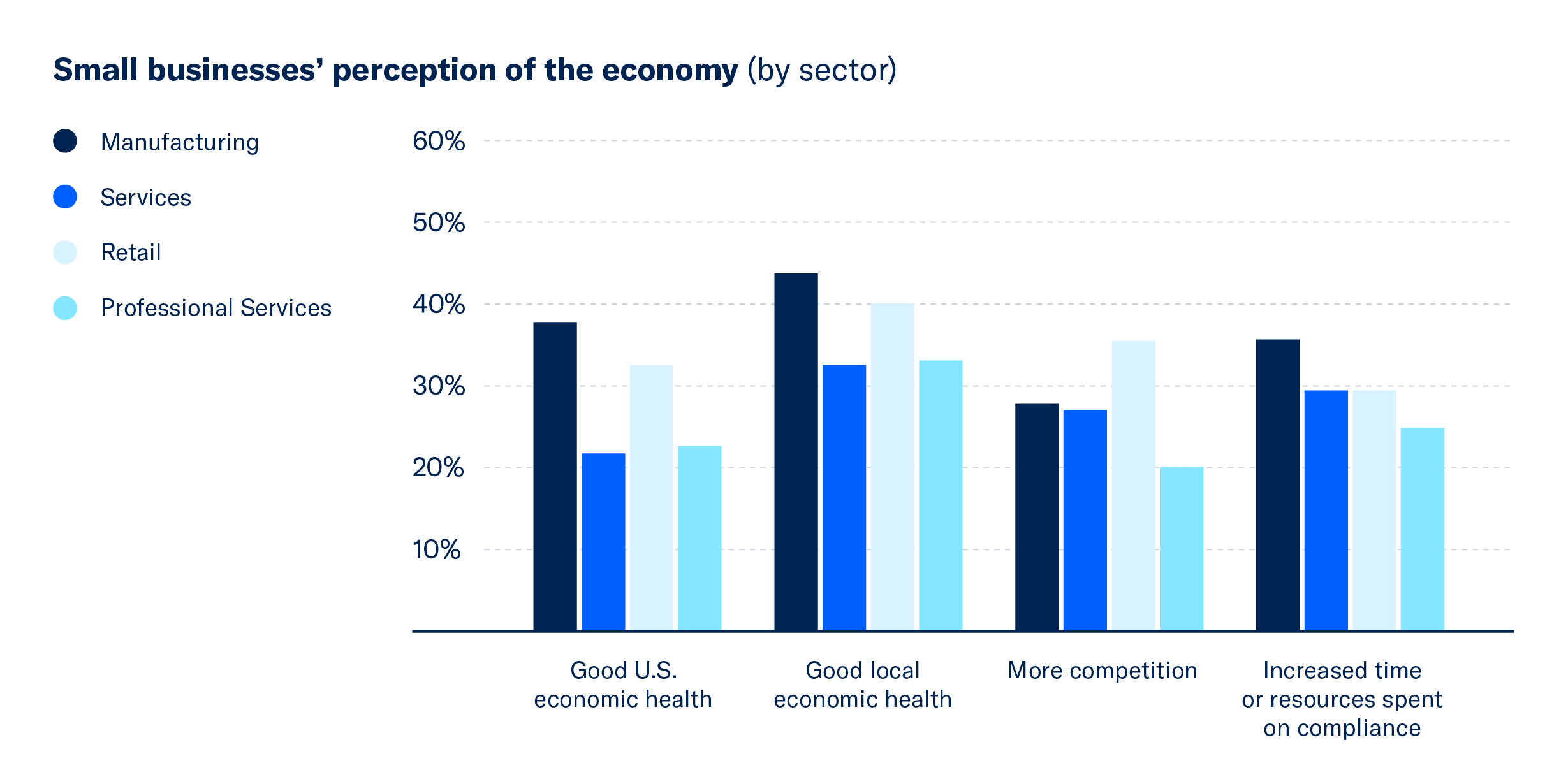
Small businesses’ perceptions of the national and local economic environment declined sharply this quarter and are now in line with Q1 2025.
Twenty-eight percent say the U.S. economy is in good health, down ten percentage points from Q4 2025 (38%) and in line with this time last year (29%). Thirty-five percent now say their local economy is in good health, down eight percentage points from last quarter (43%), but stable from Q1 2025 (37%).
Also, for the second consecutive quarter, fewer report seeing more competition in their area. Twenty-eight percent say competition from smaller or local companies has increased compared to six months ago, down from last quarter (34%).
By sector, similar to last quarter, businesses in services largely hold more pessimistic views of the national and local economies than those in manufacturing and retail. Additionally, professional services small businesses’ views of the business environment have declined this quarter and are now on par with those in services.
In a similar vein, male-owned small businesses are more likely than those owned by women to say the national and local economies are in good health, continuing a long-term trend.
Small Business Expectations: Small Businesses Hiring, Investment Plans Decline Sharply

Expectations for future investment and staffing fell sharply this quarter, while future revenue expectations are less optimistic than this time last year.
Thirty-seven (37%) percent of small businesses expect to increase investment in the next year, down from last quarter (44%) and Q1 2025 (43%). Likewise, 30% anticipate increasing staff in the next year, a twelve-percentage point drop from Q4 2025 (42%).
Revenue expectations are down, but less sharply. Three in five (61%) expect to increase revenue in the next year, a slight decrease from last quarter (65%) and down from this time last year (69%).
By sector, manufacturing businesses are more likely than those in services and professional services to anticipate an increase in staffing (42% vs. 24-26%), while retail businesses are more likely to plan to increase investment than those in professional services (45% vs. 31%).
By business size, those with twenty or more employees are more likely to expect increases in investment, staffing, and revenue than their smaller counterparts.
Similar to the last two quarters, across each measure of business expectations—future increases in revenue, hiring, and investment—businesses owned by Baby Boomers and older generations are more pessimistic than their younger counterparts.
Small Businesses Express More Concern Over The Economy Amid Uncertainty
Download One-Pager