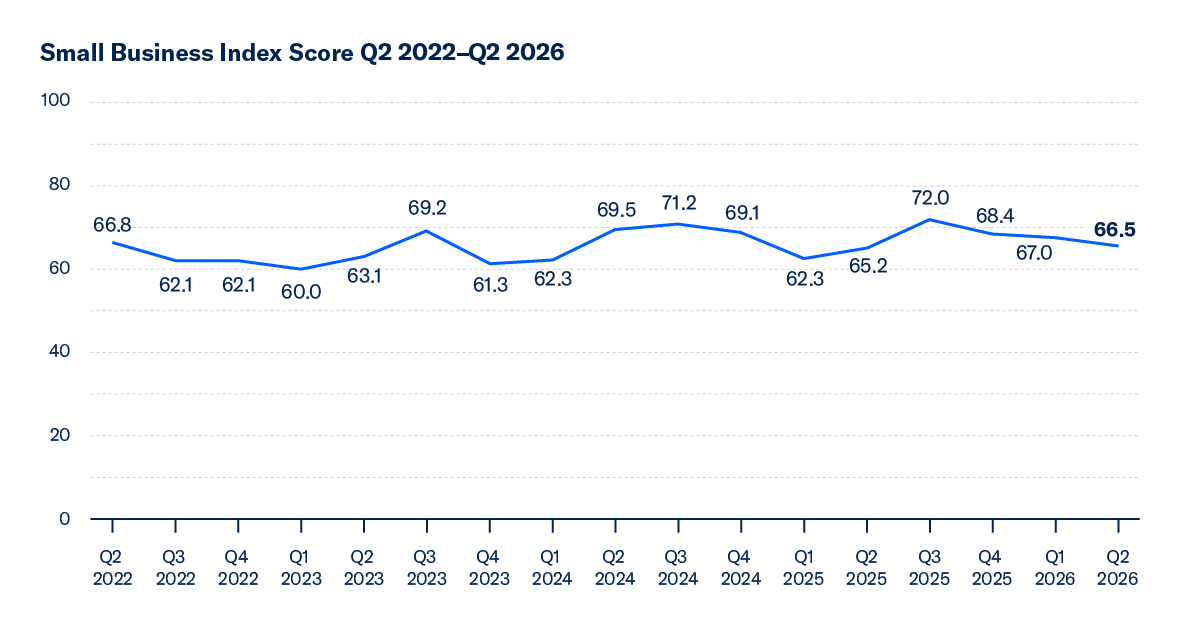
WASHINGTON, D.C. — Small business confidence held steady in the second quarter, according to the U.S. Chamber of Commerce Small Business Index for Q2 2026. The Index score is 66.5, nearly unchanged from last quarter’s 67.0, and slightly above the reading from this time last year (65.2).
Seven in 10 small business owners (69%) continue to report steady business health (was 68% a year ago), but the number citing inflation as their top concern has jumped from 48% in Q2 2025 to 57%.
Their concern about inflation appears to be showing up in less confidence in their local economy and their plans to invest.
- Positive views on the national economy – which are consistently lower than the local economy – remained similar to a year ago at 30%.
- Yet positive views of the local economy fell eight points from a year ago with 33% rating the local economy as good this quarter, compared to 41% a year ago.
“Small business owners are proving, once again, that they know how to adapt. Even with inflation topping the list of challenges, they are still confident in their own operations and expect more revenue growth and hiring in the year ahead,” said Tom Sullivan, Senior Vice President of Small Business Policy at the U.S. Chamber of Commerce. “The message this quarter is one of measured confidence: small businesses are still looking ahead, even as they navigate a tougher cost environment.”
Many still expect revenue growth and are planning to add staff, even as cost pressures remain front and center.
- 66% expect revenue to increase in the next year, up from 61% in Q1 and back near year-ago levels.
- 35% say they expect to increase staff, up from 30% last quarter, but down seven points from a year ago (42% in Q2 2025).
- Comfort with cash flow is down only slightly from a year ago (69% vs. 72% in Q2 2025).
Investment plans, however, have not followed the same path. Just 38% say they plan to increase investment in the next year—essentially flat from last quarter (37%) but nearly ten points below this time last year (47%).
“The local economy seems strong in terms of consumer activity, but many of our clients are struggling due to loss of sponsorship revenue, uncertainty, government spending changes, and other factors that are restricting business investment,” said Bryan Owen, Owner & Co-CEO of Between Pixels, a marketing agency in Marietta, Georgia.
One thing that may be lifting small business expectations: Rapid AI adoption. A new U.S. Chamber of Commerce Foundation survey found that small business employers using AI are finding that it helps people work more efficiently, improves the quality of their work, and allows them to take on more challenging tasks. Read the findings here.
About the Small Business Index
The U.S. Chamber of Commerce Small Business Index elevates the voice of America’s small business owners and highlights the important role they play in the nation’s economy. The quarterly Index conducted by Ipsos is designed to take the temperature of the sector, see where small business owners are confident, and where they are experiencing challenges.
The Q2 2026 survey was conducted online in English by Ipsos between May 19 – June 4, 2026. The survey has a sample size of 751 small business owners and operators age 18+ from the continental U.S., Alaska, and Hawaii.
About the U.S. Chamber of Commerce
The U.S. Chamber of Commerce is the world’s largest business organization representing companies of all sizes across every sector of the economy. Our members range from the small businesses and local chambers of commerce that line the Main Streets of America to leading industry associations and large corporations.
They all share one thing: They count on the U.S. Chamber to be their voice in Washington, across the country, and around the world. For more than 100 years, we have advocated for pro-business policies that help businesses create jobs and grow our economy.