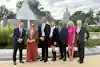
For the second consecutive year, the U.S. Chamber of Commerce led a delegation of member companies, partnering for the first time with the U.S.-India Business Council (USIBC) and jointly organized by the Chamber’s Center for Global Regulatory Cooperation (GRC) and the Chamber Technology Engagement Center (CTEC), to the fourth installment of the global AI summit in New Delhi, India. This global conversation on artificial intelligence follows previous gatherings in the United Kingdom, South Korea, and France.
The summit took place over five days, with nearly 200,000 delegates navigating New Delhi’s traffic. Hosted by Prime Minister Modi and attended by world leaders like France's President Emmanuel Macron and Brazil's President Luiz Inácio Lula da Silva, the summit was a vehicle for showcasing Indian AI to the world. There was a strong emphasis on "AI sovereignty," with a focus on the Global South developing independent AI stacks.

Advocacy in Action
Chaired by JPMorgan Chase, the delegation advocated for important policy solutions to drive further AI adoption in a complex policymaking landscape. The forum brought together digital leaders from Europe, Asia, Africa, and Latin America to tackle challenges and champion opportunities in technology with India state officials and parliamentarians.
In a Chamber-led panel, key business leaders from IBM, Zscaler, KPMG, L&T Semiconductor Technologies, and Quad Advisory discussed the interplay of quantum and AI, outlining paths to secure and commercialize the technology. Building on the theme of AI and business integration, the delegation led roundtables on ways small businesses can enhance productivity through AI adoption.
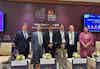
JP Morgan Chase led a conversation with the UK Department of Science, Innovation and Technology, the UK-India Business Council, and techUK. Docusign also spoke to representatives of the Indian government on AI use-cases for small businesses.
USIBC facilitated vital connections with ministers from key Indian technology states—Karnataka, Tamil Nadu, and Telangana—and hosted a salon dinner with Indian Members of Parliament.

Outcomes and the Road Ahead
The U.S. government delegation, led by Michael Kratsios, White House Office of Science and Technology Policy, used the platform to outline a U.S. federal framework and emphasize international partnership, while rejecting global governance. While the summit produced fewer policy outcomes than previous iterations, a significant achievement was India signing the U.S.-led Pax Silica agreement, aimed at securing supply chains for semiconductors and AI infrastructure.
We now look toward the next summit in Switzerland. We anticipate a return to a heavier policy focus, providing another crucial opportunity for our members to influence the global stage.
About the author

Jordan Crenshaw
Crenshaw is Senior Vice President of the Chamber Technology Engagement Center (C_TEC).