Faith Mabry
Speechwriter, Executive Communications
Updated
September 11, 2025
Published
September 11, 2025
The Global Aerospace Summit touched down Thursday with more critical insights and forward-looking ideas from the nation’s leading aerospace experts.
The final day focused on the forces shaping space and defense policy, with a spotlight on commercial innovation, private-public partnerships, and a supportive regulatory environment.
Maintaining U.S. space superiority was the driving force behind every conversation.
Whether you joined us live or caught the highlights on X, LinkedIn, or Instagram, here are the key breakthroughs, pivotal conversations, and actionable insights that defined the final day of the 2025 Summit.
DAY ONE HIGHLIGHTS: Safety, Upgrades, Workforce Are Center Stage at Global Aerospace Summit
DAY TWO HIGHLIGHTS: How Technology and Talent Will Define America's Aerospace Future
Maintaining American Leadership in Space
“We can't be number one on earth if we’re number two in space,” said Rep. Mike Haridopolos (R-FL), Chairman of the House Subcommittee on Space and Aeronautics. The need to maintain U.S. space superiority was a key takeaway from the summit, and was a prominent message conveyed by panelists on day three.
“Space is national security. Being number one in space is absolutely crucial," said Rep. Brian Babin (R-TX) Chairman, House Committee on Science, Space and Technology. "There are no prizes for second place when it comes to our space program.”
The Role of Commercial Space
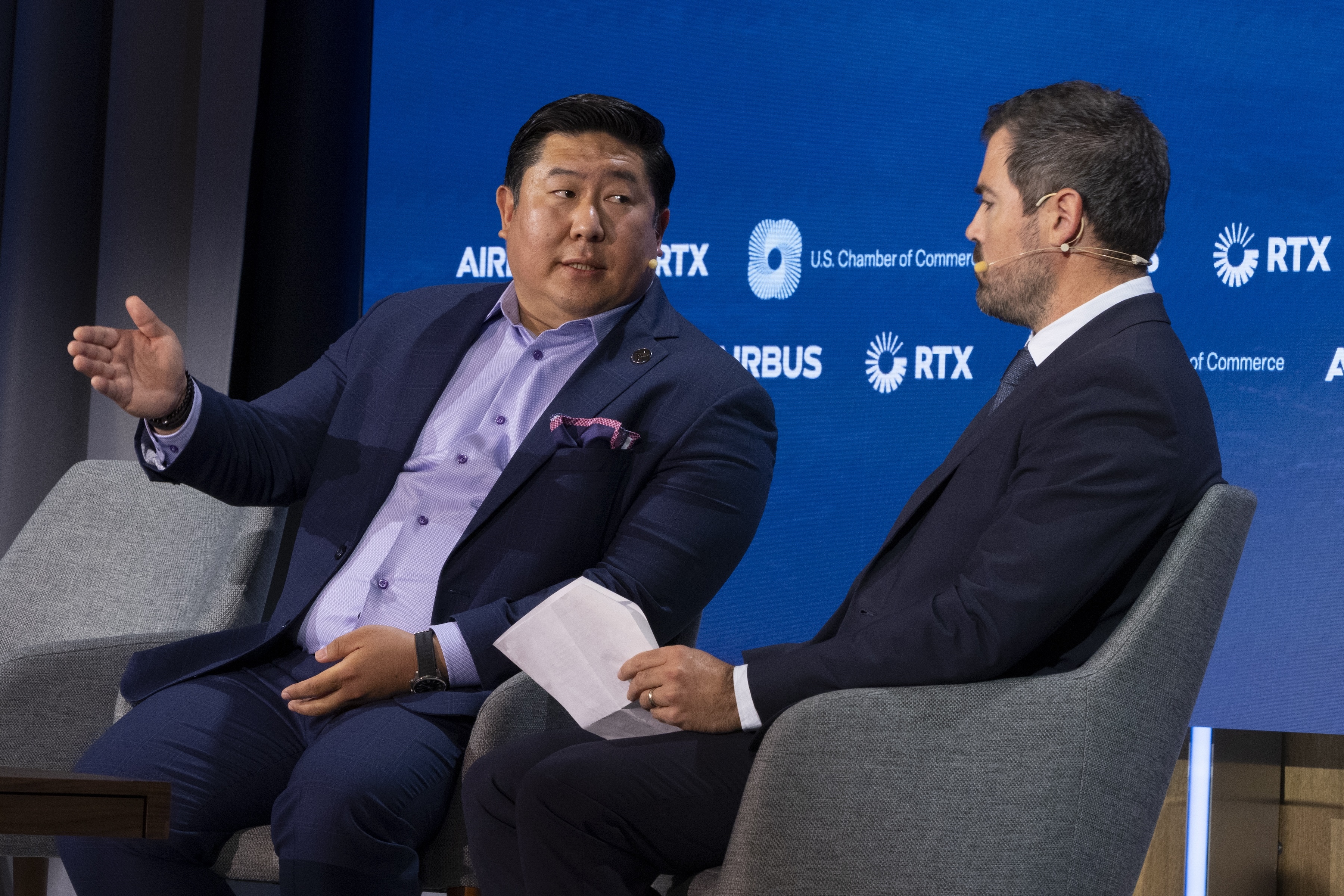
The growing commercial space industry—and its role in solidifying U.S. leadership in space—was a key focus of day three. Attendees heard directly from some of the leading commercial space companies about how their technology is supporting both civil and defense capabilities.
Firefly Aerospace CEO Jason Kim highlighted how their lunar and launch technologies have helped expand access to space. Firefly was the first private company to successfully land a mission on the moon, and Kim shared how Firefly’s capabilities are contributing to national defense.
“We’ve proven we can do 24-hour launches. That’s something that is going to be beneficial to the Golden Dome program operationally,” said Kim.
In August, Firefly completed the largest IPO ever for a space company. The “tide has shifted to a place where almost every institutional investor wants exposure [in the space industry], culminating to the largest space IPO of all time,” said Kirk Konert, Managing Partner, AE Industrial Partners LP, an investor in Firefly, who shared the stage with Kim.
Public-Private Partnerships

Maj. Gen. Dennis O. Bythewood, Special Assistant to the Chief of Space Operations at the U.S. Space Force,
underscores the critical role public-private partnerships have played in driving deterrence.

Amazon Vice President of Public Policy and Community Engagement Brian Huseman reinforced the value of government partnerships.

Robert A. Geckle Jr., CEO and Chairman of Airbus U.S. Space & Defense, Inc. discussed the history of public-private partnerships in the space industry
Speakers championed commercial-government partnership as a key driver of U.S. space leadership.
“There is a proud history of private-public partnership in the U.S. and the fusion of government and [the space] industry,” said Robert A. Geckle Jr., CEO and Chairman of Airbus U.S. Space & Defense, Inc.
Maj. Gen. Dennis O. Bythewood, Special Assistant to the Chief of Space Operations at the U.S. Space Force, also underscored the critical role public-private partnerships have played in driving deterrence in a morning panel with Kirk Konert, Managing Partner at AE Industrial Partners.
“That proliferation of capability and dynamism that we’ve seen from U.S. commercial space has driven deterrence. … It has put us at a pace that we can not only build space-based capabilities but replenish it and innovate around it at a pace that our adversaries have not been able to do,” said General Bythewood.
Speaking from the commercial side, Amazon Vice President of Public Policy and Community Engagement Brian Huseman reinforced the value of government partnerships, spotlighting the company’s investments in satellites to bring high-speed internet to underserved areas.
“To really get what we need in the space economy, with getting the satellites up, we need the government to really focus on how we can do that quicker, how we can do that more flexibly, so the FCC has really done an amazing job at being one of the leaders in the U.S. government on the space economy,” said Huseman.
Regulatory Environment that Enables Innovation
The day’s programming began with an in-depth conversation between Robert A. Geckle Jr., CEO and Chairman of Airbus U.S. Space & Defense Inc., and Brian Babin (R-TX), Chairman of the House Committee on Science, Space and Technology, on the current legislative landscape for space.
“One of the biggest issues we are facing today is overregulation,” said Rep. Babin when asked what he viewed as the most pressing issue for U.S. space and defense businesses.
Rep. Babin said overregulation stifles growth and innovation, noting that restricting industry with more regulatory bureaucracy is “the last thing we need to do.”
A regulatory framework that fosters innovation in the space industry was a key theme throughout the day.
Jay Schwarz, the Federal Communications Commission’s Space Bureau Chief, voiced his support for regulations that enable growth.
“I found a report that predicted there’s going to be a 9% growth rate in the space industry over the next decade. And I said look, just regulatory drag shaves off a few tenths of that percentage off that. We all understand how compounding works,” said Schwarz.
He noted the loss in growth was a motivating factor for him to work within his agency and others to streamline regulations that slow progress.
“Just to put a number on it, if instead of 9% it’s 8.7%, it doesn’t feel that big. But turns out, over 30 years that’s $5 trillion of loss that we don’t have. That’s what you don’t get, is $5 trillion of growth in this industry. That's motivating to me,” said Scwharz.

Susanne Hake, General Manager, U.S. Government at Maxar, discusses the diverse use cases for Maxar’s 3D imaging technology—from helping soldiers understand terrain on the battlefield to responding to natural disasters

John Serafini, CEO, HawkEye 360, Inc., and Barbara Borgonovi, President, Naval Power, Raytheon, RTX, participate in a discussion entitled, “The Future of Warfare”
Robert A. Geckle Jr. Chairman and CEO, Airbus U.S. Space & Defense, Inc., and Rep. Brian Babin, Chairman, House Committee on Science, Space, and Technology

Maj. Gen. Dennis O. Bythewood, Special Assistant to the Chief of Space Operations, U.S. Space Force

Brian Babin (R-TX), Chairman of the House Committee on Science, Space and Technology

Peter Marquez, Head of Global Security, Government, and Aerospace Policy, Amazon Web Services, and Andrew Bunker, Vice President, Government Operations and Business Strategy, Rocket Lab Corporation, participate in a discussion entitled, “Space Policy in Motion”

John Shade, Executive Vice President, Business Development and Future Programs, Rolls-Royce North America, and Jill Albertelli, President of Military Engines, Pratt & Whitney, RTX, discuss next generation engines.

Matthew J. Desch, CEO of Iridium Insights, and Loren Gush of Bloomberg, speak at the Iridium Insights panel during day three of the 2025 Global Aerospace Summit at the U.S. Chamber of Commerce.

Christopher Roberti, Senior Vice President, Cyber, Intelligence, and Supply Chain Security Policy at the U.S. Chamber, addresses the Global Aerospace Summit.

Rep. Mike Haridopolos, Chairman of the House Sub-Committee on Space and Aeronautics
Consistent Investment
In addition to regulatory certainty, industry leaders continued to stress that one of the most important things they need from government is consistent funding.
Susanne Hake, General Manager, U.S. Government at Maxar, gave an engaging presentation on the diverse use cases for Maxar’s 3D imaging technology—from helping soldiers understand terrain on the battlefield to responding to natural disasters.

“When I think about the future of satellite imagery, it’s actually not about the imagery itself per se … but it’s what we can do with that, what’s the impact that imagery can have and how do we better understand the world around us to make ultimately better decisions,” said Hake.
She noted the U.S. government must continue investing in this technology to stay ahead.
“I go onsite and visit COCOM and INDOPACOM and it’s clear they need more imagery. There is more demand than supply,” Hake said. “But in order to [scale] we need long term contracts and consistent funding in order to for us to be able to build.”
Matthew J. Desch, CEO of Iridium Communications Inc., also emphasized the need for consistent investment when talking about tracking systems for space debris. “We really need funding for those systems to get better and better to allow us even better situational awareness in space,” he said.
Breaking Down Procurement Barriers
Day three speakers united around a common challenge: America’s procurement process is too slow for today’s evolving threat landscape.
“We’ve got to move with greater speed, speed to prototype new concepts and speed to field. This has to change. We can’t take 10 to 15 years to get these capabilities in the hands of the warfighter,” said John Shade, Executive Vice President, Business Development and Future Programs at Rolls-Royce North America.
“For the defense world, it’s about speed of relevance, getting the capability to our customers extremely quickly,” said Jill Albertelli, President of Military Engines, Pratt & Whitney, RTX at a panel on next generation engines.

Beyond speed, panelists identified licensing bottlenecks as another barrier to innovation.
“I think there’s been a lot of good action on streamlining licensing, and that’s good, it’s needed,” said Andrew Bunker, Vice President, Government Operations and Business Strategy at Rocket Lab Corp. “There’s definitely improvements that can be made so I’m excited to see some of the results that will come out of the executive order and other things.”
Speakers agreed the solution is to leverage capabilities of both existing primes and smaller emerging companies.
“We have to have new entrants and those of us that have been around the industry for a long time to drive the right solutions right now. We need both. It’s not and or. But we also need to drive more scale and more sources into who supports us across our programs,” said Barbara Borgonovi, President of Naval Power at Raytheon, RTX.
Touching Down
The race for space superiority is accelerating, and America’s ability to lead will depend on our willingness to move faster, invest purposefully, and collaborate seamlessly.
The final day of the Global Aerospace Summit reinforced a critical message—American leadership in space is an imperative, and the path forward will require unprecedented collaboration.
The 2025 Global Aerospace Summit charted a path forward for the future of American Aerospace leadership.
More on the 2025 Global Aerospace Summit


About the author
Faith Mabry
Faith Mabry is an executive speechwriter on the Communications team at the U.S. Chamber of Commerce.