Faith Mabry
Speechwriter, Executive Communications
Updated
September 10, 2025
Published
September 10, 2025
It is all systems go at the Global Aerospace Summit.
The second day of the three-day premier gathering of defense, aviation, and space leaders delivered groundbreaking insights on the future of aerospace.
Technology's role in addressing evolving threats emerged as a key theme throughout the panels. Industry and government representatives discussed new capabilities in defense and aviation, with particular focus on AI, workforce development, and maintaining U.S. leadership.
Whether you were in the room, catching up, or following along with us on X, LinkedIn, or Instagram, here’s your recap of the standout moments, guiding themes, and mission-critical insights from day two.
CATCH UP ON DAY ONE: Safety, Upgrades, Workforce Are Center Stage at Global Aerospace Summit
SEE DAY THREE HIGHLIGHTS: Securing U.S. Space Leadership via Innovation, Partnerships, Policy
Responding to an Evolving Threat Environment
The morning kicked off with an insightful conversation about America’s defense capabilities in an evolving threat environment, featuring Rep. Dale Strong (R-AL), Co-Chair of the House Golden Dome Caucus, and Phil Jasper, President of Raytheon, RTX.

Jasper noted the myriad threats facing the United States—from low-flying UAVs to weapons from space—and the critical role technology will play in responding.
“There's no one defensive system in integrated air missile defense that can handle that complete range of threats,” he said. “And so from our perspective, from a technology standpoint, is, how do you build a layered system to deal with those close in threats?”
Rep. Strong shared his strong support for bolstering America’s defense capabilities through consistent, full-year appropriations bills and sending consistent demand signals to the industrial base.
“What we're doing is trying to get people in Congress to understand you can't staff for [inconsistent orders]. Let's be consistent in our orders and let's make it work for everybody,” said Rep. Strong.
Groundbreaking Technology Enhancing Capabilities
Industry leaders dove deeper into new technology driving the aerospace industry forward.
Paul Touw, CEO of Otto Aerospace, shared how their next-generation aircraft will leverage full laminar flow technology, which helps reduce emissions for commercial and defense aviation.
“If we can get aircraft to behave in laminar flow it represents an enormous potential reduction in the energy required to sustain flight,” said Touw.

Technology’s role in enhancing defense capabilities was at the forefront of a panel between Kyle Clark, Founder and CEO of Beta Technologies, and Scott O’Brien, Vice President, Legislative Affairs at Reliable Robotics.
“At Reliable Robotics we are working on remote piloting and aircraft autonomy … so we are designing a highly redundant autonomy system that enables auto taxi, auto take off, auto landing and what is really important is that it fully integrates into the National Airspace System,” said O’Brien.
Clark also offered valuable insight into Beta Technologies’ work on advanced air mobility (AAM), which enables faster and more flexible transportation in aviation and defense.
“It’s great to see how AAM is transforming the way military is buying aircraft — it does not have to buy exquisite billion dollar aircrafts,” Clark said when commending the military’s leadership in incorporating new capabilities into their existing fleet.

The main entrance to the U.S. Chamber welcomes guests to the three-day Global Aerospace Summit

Christopher Browne, the John and Adrienne Mars Director of the Smithsonian’s National Air and Space Museum, said the museum connects past and present aerospace history by supporting changemakers in industry and government. “We may be telling the story, but [industry] are the ones writing it.”
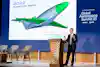
Paul Touw, CEO of Otto Aerospace, shared how their next-generation aircraft will leverage full laminar flow technology, which helps reduce emissions for commercial and defense aviation.

Elaine P. Ho, Associate Administrator, Office of STEM Engagement, NASA, participates in a conversation entitled, “Tomorrow’s Aerospace Leaders”

Kevin McAleenan, CEO of BigBear.ai, shared how his company is providing AI-powered decision intelligence to respond to emerging threats.

Senator Mark Warner (D-VA) emphasized the importance of securing American technological leadership over China, highlighting the national security risks of U.S. dependence on Chinese critical minerals, during a conversation with Rodney Davis, Head of Government Affairs at the Chamber.

Joanna Geraghty, CEO, JetBlue Airways Corp., in conversation with Phil LeBeau of CNBC

Maryland Gov. Wes Moore and Virginia Gov. Glenn Youngkin shake hands outside the green room between their panels during the Global Aerospace Summit.

Rep. Dale Strong (R-AL), Co-Chair, House Golden Dome Caucus, and Phil Jasper, President, Raytheon, RTX, discuss “America's Defense: Golden Dome”, with Keith Webster, President of the Chamber's Defense and Aerospace Council
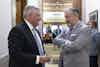
Sen. Ted Cruz talks with Neil Bradley, Executive Vice President and Chief Policy Officer at the Chamber.

Jason Birnbaum, Chief Information Officer, United Airlines Holdings, Inc. said, "We believe that AI will enable our employees to scale up in these situations and provide better responses faster, as well as being able to use AI to get you on your journey faster.”
Artificial Intelligence
The expansion of technology—particularly AI—in all aspects of aerospace and defense continued to dominate conversations on the main stage.
United Airlines Chief Information Officer Jason Birnbaum joined the Chamber’s Sean Heather, Senior Vice President, Internal Regulatory Affairs & Antitrust, to discuss how the airline is deploying generative AI to improve the customer experience and reshape their business.

“We believe that AI will enable our employees to scale up in these situations and provide better responses faster as well as being able to use AI to get you on your journey faster,” said Birnbaum.
AI is transforming the aviation experience for consumers and bolstering our national defense capabilities.
Kevin McAleenan, CEO of BigBear.ai, shared how his company is providing AI-powered decision intelligence to respond to emerging threats.
“It’s transforming every aspect,” McAleenan said in response to Jay Sapsford, Senior Vice President of the Chamber’s Global Intelligence Desk, when asked how AI is changing the national defense posture.

“We’re seeing impact about how planning works at the senior level of the Department of Defense all the way down to the tactical edge—how warfighters are making decisions, how we’re reducing their cognitive load and enabling them to see more of the environment around them and rapidly respond.”
Securing the U.S. Advantage
As AI continues to revolutionize our aviation and defense capabilities, maintaining America’s edge in space and technology was at the forefront of the minds of Congressional leaders.
“If America does not lead in space, China will,” said Senator Ted Cruz (R-TX), Chairman of the Senate Committee on Commerce, Science, and Transportation to a standing-room only crowd.

Sen. Cruz underscored the need for American leadership while providing a timely update on the federal government’s aerospace investments in the One Big Beautiful Bill Act, which included $12.5 billion for life-saving efficiency and safety enhancements and $10 billion for NASA.
“The investments in this Congress are not just line items in a budget fueling a partisan agenda. They are meaningful commitments to safety, innovation, and leadership. They are proof that when we act intentionally with purpose, we deliver,” said Sen. Cruz.
The need for U.S. leadership in space was also underscored by Rep. Salud Carbajal (D-CA), who told U.S. Chamber Head of Government Affairs Rodney Davis that the biggest priority for the space industry should be space superiority.
“We need to make sure we are a step ahead, and able to detect, deter, and defeat any threat that we have,” said Rep. Carbajal.
Senator Mark Warner (D-VA) emphasized the importance of securing American technological leadership over China, highlighting the national security risks of U.S. dependence on Chinese critical minerals.
“China has monopolized the processing of critical minerals. More than 90% of these critical minerals are processed in China. That is a national security risk, and we have to put pedal to the metal,” said Sen. Warner.

Building a Skilled Aerospace Workforce
Echoing a common theme from day one, panelists continued on Wednesday to highlight the need for a skilled aerospace workforce.
Policymakers, educators, and industry leaders spoke of the importance of getting students excited about the industry from an early age and encouraging alternative pathways to STEM.
Louisville, Kentucky, Mayor Craig Greenberg highlighted his city’s focus on workforce development.
“Workforce is incredibly important. One of the things we are doing in Louisville is a program in the High School called Academies of Louisville. The path for every high school graduate is no longer only college … they have programs in the high school to get kids ready for jobs,” said Greenberg.

Ranking Member of the House Subcommittee on Strategic Forces Seth Moulton (D-MA) also noted his support for pathways outside the traditional four-year degree to build the aerospace workforce.
“We got GE to invest in our local schools, to invest in vocational training programs, and now there’s a real pipeline to kids from school into great career paths,” said Rep. Moulton, “And It's making a huge difference in our local economy as well as supporting our national security.”
Education leaders discussed how to align curriculum with the skills tomorrow's aerospace leaders will need. Beyond technical expertise, panelists stressed the importance of business acumen, emotional intelligence, and adaptability.

Elaine P. Ho, Associate Administrator of STEM Engagement at NASA, emphasized the importance of welders, electricians, and sheet fabricators in the aerospace talent pipeline.
“NASA has ramped up this concept of Aerospace State Hubs focused on the skilled technical workforce because this is mission critical for us and we do not have a pipeline,” she said. “For us to get to the moon and mars we need that pipeline and we do not have it.”
Gaining State-Level Insights
Virginia Governor Glenn Youngkin and Maryland Governor Wes Moore each took the stage to share how their states are shaping the future of the aerospace industry.
Governor Moore (D-MD) credited his state's first-rate higher-education talent pipeline as a driver for Maryland’s growing aerospace industry.

“One of the things we really value ourselves is the talent within our state,” he said. “There’s an extraordinary pipeline of higher education talent. It’s one of the reasons Maryland has the highest percentage of engineers and PhDs in the United States of America.”
Governor Youngkin (R-VA) spotlighted Virginia’s business-friendly environment, telling the Chamber’s Executive Vice President, Chief Policy Officer, and Head of Strategic Advocacy Neil Bradley about the efforts he’s undertaken to attract aerospace business.
“At the top of our list has been streamlining regulations,” said Governor Youngkin. “If you need an air permit or a water permit, it takes 30% of the time it did three years ago.”

Governor Moore noted that regional collaboration and friendly competition between the two states act as a positive force for the aerospace industry.
“I think one of the real assets of Virginia is Maryland. And one of the real assets of Maryland is Virginia. There's a regional focus I don’t think we should lose. We’re always going to compete,” said Governor Moore.
Looking Ahead
Day two of the Global Aerospace Summit reinforced that America's aerospace leadership depends on our ability to leverage emerging technologies, develop a skilled workforce, and maintain strategic advantages over global competitors.
The summit concludes Thursday with more can't-miss conversations from the world’s leading voices in defense, aviation, and space. Register at the door of the U.S. Chamber to attend day three. Check out the agenda here.
More about the 2025 Global Aerospace Summit


About the author
Faith Mabry
Faith Mabry is an executive speechwriter on the Communications team at the U.S. Chamber of Commerce.