Space

The global space industry is opening new markets and transforming our economy. Valued at nearly $450 billion and growing, the space industry is driving exhilarating technological progress that is helping advance many other industries, such as telecommunications, defense, bioscience, manufacturing, and energy exploration.
Our perspective

U.S. Chamber report examines how commercial innovation in Low Earth Orbit (LEO) is reshaping U.S. national security and what policymakers can do to sustain America’s advantage in space.
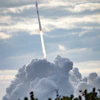
The Trump Administration's Executive Order fortifies the commercial space industry by streamlining regulations, modernizing infrastructure, and fostering innovation. In doing so, it sets the U.S. up to lead the next phase of space exploration and economic growth.

What a crewed Artemis II lunar mission means for industry and American space leadership.
Shaping the future of space policy


Our Work
Every day, more businesses are considering the commercial potential of space. The U.S. Chamber is working closely with government and industry leaders to turn potential into a reality. We are advancing public-private collaboration needed to support space exploration and commercial and private aerospace travel as well as to create guidelines for managing traffic and commerce. We are also helping government leaders shape smart regulations to drive innovation and growth in this emerging sector so people, businesses, industries, and economies everywhere can benefit from the limitless possibilities of space.


Watch Now
Amy C. Roma, Global Energy Practice Leader at Hogan Lovells, outlines the use cases of nuclear power in space at the Global Aerospace Summit 2024.
U.S. Chamber members range from small businesses and chambers of commerce across the country to startups in fast-growing sectors, leading industry associations, and global corporations.
Discover the ROI Chamber membership can deliver for you.
Latest Content
- Hosted at the U.S. Chamber of Commerce with NASA’s Earth Science Division, the NASA Earth Science Industry Day made one point clear: Earth observation data is now economic infrastructure. Leaders from NASA and major risk, agriculture, and real-estate users underscored that the next decade must focus on turning “data for discovery” into “data for decisions”—with trusted, usable, and continuous Earth data powering resilience and competitiveness.On March 11, 2026, the U.S. Chamber of Commerce submitted an ex parte filing in the FCC’s “Space Modernization for the 21st Century” NPRM (SB Docket No. 25-306). We support faster, more predictable space and earth-station licensing—while emphasizing that streamlining must preserve transparency, stakeholder participation, and incumbent spectrum users’ legally protected rights.Jim Bridenstine joins Neil Bradley to discuss the forces driving the new space race—highlighting the Artemis II launch, rising U.S.-China competition, and the intersection of national security, satellite technology, and commercial investment.This Hill letter was sent to the Members of the United States Senate Committee on Commerce, Science, and Transportation in support of S.933.This Hill letter was sent to the Members of the U.S. Senate Committee on Commerce, Science, and Transportation.The Chamber sent a letter to Secretary Hegseth supporting the Department of War’s new warfighting acquisition reforms to speed capability fielding and strengthen the defense industrial base while promoting active competition.This Hill Letter was sent to the Members of the United States Senate on the nomination of Jared Isaacman to Serve as Administrator of the National Aeronautics and Space Administration (NASA)This Hill Letter was sent to Members of the Senate Committee on Appropriations supporting the expansion of Combatant Commander (COCOM) access to commercial remote sensing data and analyticsThe U.S. Chamber of Commerce submitted comments on the European Union’s proposed Space Act. While we support efforts to strengthen Europe’s space sector, the Chamber urges the EU to adopt a market-driven, innovation-friendly framework that promotes collaboration, sustainability, and competitiveness without imposing unnecessary restrictions. Read the full comments below.The final day of the 2025 Global Aerospace Summit focused on the forces shaping space and defense policy, with a spotlight on commercial innovation, private-public partnerships, and a supportive regulatory environment.